
Why You Don't Save For Retirement

How do you envision your future retirement?
Some shocking statistics recently caught my eye. The median IRA balance is just $55,000, and the median 401(k) balance is just $15,000. Baby boomers are working longer, since most do not have enough saved to retire comfortably. And, given the statistics, it’s likely you are in the same boat.
Why is it that so few of us save enough for retirement? Why are we so woefully underprepared?
I usually search for answers for these thought-provoking questions in marketing books. Often I find that lack of good marketing is underneath a lot of personal finance problems. Car manufacturers are great at showing off the sleek curves of their latest model, but “retirement” typically doesn’t have flashy commercials. But is it really that simple?
While reading the book Made to Stick recently, I came across an interesting principle: concreteness. The authors, Chip Heath and Dan Heath, describe it as one of the features necessary to make an idea stick in your mind. They cite an example of The Nature Conservancy, a nonprofit organization dedicated to preserving land. When they touted how many acres of land they wanted to save, people simply weren’t interested. But when they showed a particular piece of land they wanted to save, and named it “Mount Hamilton Wilderness” (after a local mountain), people flocked to help them.
Why is this? Our brains aren’t wired to have a tangible picture of “1,000 acres”, but they are wired to understand “Mount Hamilton Wildnerness.” Making something tangible — giving us the picture in our minds — makes it meaningful.
How does this relate to retirement?
One huge factor in why we don’t save for retirement might simply be that we lack a visual anchor in our minds for the word “retirement.” In other words, if I ask you to define “retirement”, you probably won’t have a quick answer. You may visualize some old person fishing or sipping a Mai-Tai on the beach, but you probably won’t relate that to yourself.
But if I ask you to define “watermelon”, you can probably visualize not only the fruit itself, but one or more times where you’ve eaten it, smelled it, or seen it.
How do you avoid the trap of buying tangible objects such as houses and cars instead of saving for retirement and investing? You start by making the things you desire tangible.
Making Retirement Tangible
There is probably something you spend $5 a day on that you could do without. A daily coffee; a Coke or two from the vending machine; a lunch out instead of brown-bagging it; premium cable TV and video games. Whatever it is, no matter how silly–write it down. Chances are you can easily visualize whatever it is. You can probably remember the last time you used it (especially since it probably hasn’t been that long ago!)
$5 a day, invested at an 8% annual return for 30 years, is over $228,000. (It’s actually even more than that, since you’re investing daily or monthly instead of annually.)
The problem is that’s where most personal finance authors stop. They show you a latte vs. $228,000 and expect you to be in awe. They expect that you will do the logical thing and cut out the latte.
Since Starbucks is still in business, that obviously doesn’t work.
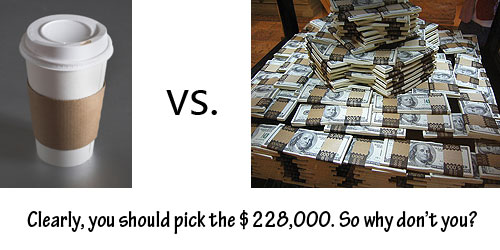
Why don’t you pick the money? Simple: $228,000 is not tangible. It doesn’t have meaning or value to you. Those lattes hold an emotional significance and a value to you, but $228,000 does not.
Our next step, then, is to make $228,000 actually worth something to you.
What $228,000 is worth to you will be different for every person. Let’s assume for now that you plan to retire with your newly found $228,000. (By the way, if you plan to retire in 40 years instead of 30, that $228,000 becomes nearly $535,000!)
Now that you have visualized the video games, coffee, movies, or whatever you’re spending money on now, the next thing to do is visualize what you want out of retirement. So you have your $228,000 (or $535,000.) What are you going to do with it?
If you write down some lame one-word answer like “fishing”, by the way, I will kick you.
Visualizing Your Retirement
How about this retirement option? “For my retirement, I’m going to sell some of my possessions, take 4 years and travel the world. During those 4 years, I plan to see Paris and buy a designer dress, go to Switzerland and ski the Alps, and head to Australia and try a vegemite sandwich. I’ll save some money by living cheaply, and I will learn to speak at least one other language.”
Or this? “I plan to move to Mexico and rent a gorgeous beach house. I will enjoy living in a community with multi-cultural folks who love a warm, sunny climate. I’ll learn how to wrap a burrito so the stuff inside it doesn’t fall out, and I will teach music–particularly piano–to others to make a little pocket change.”
What’s happening here? Suddenly, your retirement is becoming real. If you do this right (look at travel magazines and talk to others for ideas), you’ll feel a shift in your thinking. Suddenly that latte doesn’t seem appealing…not when your dream is put off another day into the future!
Want to seal the deal? Find a picture or two that you feel represents your future retirement and place them where you will see them every day. If you feel so inclined, write something inspirational on the pictures. Maybe you can even think of a catchy saying to remind yourself of what’s really important. What about “A Coke a day keeps my retirement at bay?”
Most of us haven’t even taken a few minutes to think about what we really want out of retirement. No wonder, then, that nearly 50% of us choose to cash out our 401(k)s instead of rolling them over. It’s not just about how much money you will need to retire and when you can afford to retire; it’s about making retirement tangible. Real. Beautiful, even.
On Buying a House
This same line of thinking helps us understand why people buy a house, even at their own financial peril. Even when they know that renting and investing the difference could make them a millionaire, they still choose to buy.
Why? Simple: “Investing” isn’t tangible. Neither is “a million dollars.” (You can’t picture “a million dollars” as easily as you can a watermelon.) But a house is tangible. You can see it, walk around in it, live in it. I could just have easily named this article “Why Most People Buy A House Instead of Becoming a Millionaire.”
If you have a spouse or significant other who is interested in buying a house — or there is even part of you that desires it — numbers probably won’t change your mind. But what if you consciously decide to rent for less money every month and invest the difference? Remember to make it tangible. “If we choose to rent our current place instead of buying a house, we can afford to go on a vacation to Europe this year.” Maybe you can retire five years earlier than if you owned a house. (But remember to plan out exactly what you’re going to do once you do retire!)
Once you add in property taxes, home maintenance, water, garbage, and HOA or Mello Roos fees, renting a home typically comes out ahead. In fact, a recent study showed that middle-age renters in 2004 were more wealthy than the equivalent homeowners. Use this to your advantage and enjoy your rich life!
Take a few minutes now to sketch out and visualize your dream retirement. Discuss your plans with your spouse or significant other. Make it as tangible as possible. Maybe you can even start working toward it in other ways (learning the language of a country you want to live in, for instance, or planning a small trip to a potential place to live.) The more real you make it, the more likely you will be to save for it.
And remember: An indulgence today will lead your retirement astray!
Recommended Reading:
- Made to Stick. If you are selling a product, or if you are interested in why certain stories and commercials seem to stick in your head better than others, this is the book. Well worth reading.
- The Impending Retirement Crisis at MoneyNing. David does a good job of breaking down why our country is facing a retirement crisis.
- One Decision That Can Make Anyone a Millionaire.Can buying a used car instead of a new one really make you $1 million? I break it down.
- Carnival of Personal Finance #199. This post was an Editor’s Choice!