Erica Douglass, entrepreneur and writer About Erica Contact Erica Erica's Goals Erica's Public Speaking erica.biz Archives Erica Douglass

Hi, I'm Erica Douglass. I sold my business and "temporarily retired" at age 26. I write here about investing, setting goals, and entrepreneurship. Most importantly, I share lessons I have learned that can help you on your quest for financial freedom!
Get started by reading my latest blog post, or browsing my favorite blog posts.

One Decision That Can Make Anyone a Millionaire

For most of us, having a million dollars liquid — that is, available for our use at any time, and easily convertible into cash — is the stuff of pure fantasy. But after talking to a few of my friends about decisions they were making, I was able to easily articulate one way we can all have $1 million in cash — liquid, available cash — in our lifetimes.

No, this isn’t some “get rich quick” scheme, and it doesn’t require anything illegal or immoral. It’s actually quite simple. The one catch is that it’s easier to do earlier in your life. But it’s something anyone can do, and is easily within the range of most Americans. You have to follow some rules to make this work. But once you do, you’ll be a millionaire.

What is the decision?

Buy a cheaper car, and invest the difference.

Yep, that’s it. Let’s break this down: how does buying a cheaper car make you into a millionaire?

For this exercise, I am going to assume you are 30 years old, and you want a million dollars by the time you are 70. Let’s also assume for the sake of argument that you are interested in a car that costs $35,000 new, and you have little or no down payment. This seems fairly accurate given the data I found from Edmunds in 2004 that states that the average new motor vehicle MSRP was $30,841 in December 2003. We can safely assume that number has gone up since then. Factoring in taxes and licensing, $35,000 seems a reasonable estimate of what the average new car costs.

$35,000 over 6 years, at an interest rate of 8%, is $613.66 per month. Whew, that’s quite the car payment! But it’s similar to what many 30-year-olds have.

Where does the million dollars come in? Spend $24,000 on that car instead of $35,000, which you can easily do by getting a used car or a slightly cheaper car. Your car payment over the same term is $420.80 per month, or a savings of $192.86. Round that up to $200 per month, and put that $200 per month into a mutual fund earning 10% per year. Here’s the catch: You have to invest the extra $200. You can’t blow it on food, TV, music, etc. I strongly recommend you find an investment service that will take the money directly out of your paycheck so you won’t be tempted to spend it.

Once you’ve done that, find a mutual fund that will give you high returns on your money. This shouldn’t be too hard. If you’re unsure, the S&P 500 index has returned an average of 10.30% over the past 30 years (1976-2006.) Pick a S&P index fund, put $200 in it every month, and leave it alone!!! for the next 40 years. Let the compound interest magic work for you.

Invest $200 a month at 10% for 40 years, and you will have a cool $1,168,444.35 saved up for retirement. If you are still having trouble deciding what you want to do, I recommend you visualize a pile of $1.1 million dollars in cash and a used car on one side, and a brand-new car on the other. Which would you rather have?

Here, I’ll help you out:

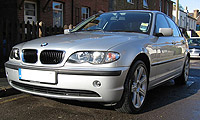
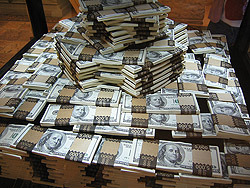
2003 BMW 3-series (approximately $24,000 used) and ONE MILLION DOLLARS IN CASH!!!
  

2007 BMW 3-series (approximately $35,000 MSRP) and what you will be stuck with

  

I’d pick the $1.1 MILLION DOLLARS IN CASH any day.

I am sure some of you are saying, “But Erica, spending $35,000 on a car is ridiculous! I would never do that.” Well, good for you! Seriously. Now go invest that $200 anyway. Which is more interesting, a couple pairs of shoes or $1.1 million? 10 DVDs, 5 of which you’ll never watch again anyway, or $1.1 million? You get the idea!

Go set up that investment fund, and go set up your paycheck to deduct into it. If you’re self-employed, set it up to withdraw from whenever you pay yourself. In 40 years, when you’re living the high life, you can toast me from the helm of your beautiful boat that you bought with your spoils. ;)

Photo credits: BMW photos by xrrr. Cash photo by noahwesley. Sad Mac photo by Inkington. All photos licensed under Creative Commons.


Like this entry? Subscribe to this blog and receive an email update whenever a new post appears on the site! No spam, and I won't give your email address to any other company.

Email This Post To A Friend Email This Post To A Friend

book mark One Decision That Can Make Anyone a Millionaire in del.icio.usBookmark in Del.icio.us  |   See this page in technoratiTechnorati  |   submit One Decision That Can Make Anyone a Millionaire to digg.comDigg This!  |   review One Decision That Can Make Anyone a Millionaire on StumbleUponReview on StumbleUpon


Previous post in this category: The 3 Cornerstones of Successful Forex/Stock/Options Traders

9 Responses to “One Decision That Can Make Anyone a Millionaire”

  • sethkills:

    Wow, it’s like you’re psychic! I’m about to buy a 2003 3-series, and all of my coworkers think that I’m an idiot for not spending $500+/month on a new car like they do. Putting what would be my car payments into an index fund seems like the logical next step towards not squandering the savings somewhere else.

  • http://technorati.com/people/technorati/marcin:

    Don’t forget about inflation though. You know how “old people” always go on about how “back in my day, a car only cost $20!”. $1 million in 30 years will not be what $1 million is today. You’d probably need $2 million to get you what $1 million does now.

    It would still be nice to have the money though, but doubtful you could retire on it without other investments. I know you’re not saying “this is all you need” though.

    Another financial strategy people use is to rent rather than buy, and invest the difference between mortgage payments and rent. Here in Australia, even though rents have gone up recently, I know mortgage payments on the place I’m living in would be about double the rent I’m paying. And probably 95% of that (in the first few years at least) is interest payments - just as “dead money” as rent is.

    Anyway, everyone’s situation and financial goals are different - ie. some people want the security of owning their own place NOW irrespective of whether it’s a good strategy at that point of their lives.

    Personally I’m going to wait another 5-10 years (I’m only 29 now) and go into the housing market getting a place that will suit my family for the long term (rather than compromises I’d have to make now), with a sizable deposit and a small mortgage that can be paid off quickly.

    Wow, that was a longer comment than I expected.. maybe I need to revive my blog :)

  • http://tikitropicana.livejournal.com/:

    That’s super interesting. Funny how when you analyze these things they can actually make a huge difference!

  • http://aeropreneur.livejournal.com/:

    Hi, I ran across your blog last year, and am back via the magic of RSS. Good luck with your new website, it sounds interesting.

    Yeah, despite what they may say, you can tell a lot of folks don’t really think like capitalists by the way they blow money on cars.

    You can go too far with this (I’ve heard of millionaires who still drove old cars), but anyone contemplating a purchase should be asking what else they could do with that money.

    Of course, this mindset can help you save $$ with other sorts of purchases, too!

  • Russ Gonsalves:

    1- Posting to try out my OpenID setup…

    2- I’m doing something similar. Getting an A6 for around $8k and paying it off with ESPP funds.

  • SavingDiva:

    Just imagine how much money you would be able to save if you forgo a car and just ride a bike….

    I have to admit that I drive a 2000….my friends and family think I’m crazy…and I need to buy a new car. However, I plan to drive it until it dies, and then I’ll think about buying another one…probably used…

  • b:

    Erica,
    geat site, love your articles. I completely agree with most of the things you write and I just wish more people like you would decide what gets taught in our public schools.
    Now, that being said: 200 bucks a month for a lot of cash in 40 years. Another 400 bucks for college for the first kid in 15 years. Another 300 for the second kid’s college in 18 years. Say 200 into 401k especially if my company matches, it’s a sin not to do that. 200 on top of the required mortgage payments b/c it makes a lot of sense to pay your debt off early. Right now we’re talking about saving 1300 dollars on top of the regular payments (mortgage + car + bills + ???, say 2,5k) to make my life easier in 20+ years. So I have spent 3.8k to ensure the infrastructure around me and make sure my life will be easy in the far future. See where I’m getting at? :) I guess my bottom line is: I’m about to buy a $15.000 car. How can I save 1.3k on the monthly payments? ;)

  • Grace:

    I like your blog, I am hoing to RSS. I am also going to take up your challenge about complaining, I will start tomorrow though, I gotta get things out of my system first. :-)

  • Christine:

    I would like to add one point though - you often can not get the 6 year, same interest rate terms on a used car as you can get on a new one. It is why I’ve purchased new the last two times I’ve bought a car - the interest rate was better, and I had the option of longer terms if I wanted them. Oh, and realistic payoff options, not some bizarre ones that charge you interest for the whole loan even if you pay off early (seems illegal to me, but I didn’t question it as I didn’t go that route.)

    I also purchased new cars after having the experience of used with more frequent repairs required. That cut into my ability to save money if I was spending it on repairs.

    How do you feel about leased cars? Especially if you drive them for business purposes?

Leave a Reply

XHTML: You can use these tags: <a href="" title=""> <abbr title=""> <acronym title=""> <b> <blockquote cite=""> <cite> <code> <del datetime=""> <em> <i> <q cite=""> <strike> <strong>


Google