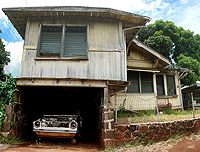
I did the math, and I think our society has been sold a pile of crap that we’ve bitten on hook, line, and sinker. I’m not going to mince words or try to make this sound nice, because we’ve been duped, and we have every right to be upset about it.
Let’s rewind a bit and figure out where this particular dupe came from. Several decades ago, the “norm” was to work for one company for most of your adult life, with the assurance that they would provide for you for the rest of your life. My grandfather, in fact, still lives comfortably in a retirement community on pensions from the government and a university where he worked, as well as Social Security. He will be 87 years old next month.
My parents’ generation (my father will be 65 this year) was raised on those ideals, but it didn’t often work out for them that way. My father will grumpily point out that some of his friends who worked for corporations their entire careers have pensions, but he has “nothing”. My parents are both self-employed and are somewhat miffed that they didn’t get to partake in that.
This myth has slowly unwound all the way down to our generation. People in the 21-35 age range, including me, don’t have any illusions about working for any specific company and having that company pay for their retirement. The younger people you talk to don’t believe we will have Social Security to help us, either.
In the span of 2-3 generations, then, we have gone from working for one company as the ideal, to switching jobs every 3-4 years and not really having any idea of how to save for retirement past a 401(k) or similar plan.
What does this have to do with housing?
Housing has had a similar change, but I don’t think we’re aware of it. In fact, housing has shifted so radically in the past 9 years that we’re still trying to unravel the mess. Just 9 years ago, it was possible to buy a house right here in San Jose, CA for about $325,000. Remember, this was in the middle of the dot-com boom. I lived here in San Jose in 1999. I remember the crazy traffic, the 6-8 week waiting lists just to get a crappy apartment, and the scary projections in the San Jose Mercury News that we would never be able to build enough freeways to sustain the crazy population growth we had here.
It seemed that every week there would be another story of a young dot-com millionaire. I watched several of them get made — I worked for Cobalt Networks, and our stock price rose 618% in its first day of trading on NASDAQ. Everyone who was middle management or higher got their “golden ticket”. I watched multi-millionaires get created before my eyes. (No, I was not one of them!)
Yet houses still only sold for half of what they do now.
It is now so much cheaper to rent than to buy — not only here in the Bay Area, but in most high-cost locations in the country. I’m going to do the math and break down why it’s better to rent than to buy. Then I’m going to show you exactly why you won’t listen to the math…and what should sway you to seriously consider not buying a house instead.
The math
I live in a 3BR, 900sq.ft. duplex in the 95118 zip code. I’m going to pick a similar house in the area and estimate what my rent payments would be vs. mortgage payments, property tax, and maintenance on the house. Keep in mind that I won’t use “peak” housing prices here, but the prices as they stand today — about 15% down from the peak.
My rent: $1650/month — recently raised by $50/month so the landlord could install central heat and A/C. (Previously, we just had a gas heater on the wall.) My landlord lives in the other half of the duplex.
We’re going to use MLS #770964 as the comparison house. It’s a single family home in my zip code. It appears from the listing to have central heat and A/C. It is also 960 square feet…slightly larger than my current rental. It appears from the pictures to be in fairly good condition. It’s currently priced at $522,200, making it one of the lowest-priced houses in my zip code, and has been on the market for 40 days. To make a completely fair comparison, we’ll stipulate that the house buyer has agreed to accept $510,000 on our “offer”. We need to come up with a 10% down payment to buy this house.
Down payment: $51,000
Closing costs: (We’ll be generous and assume the seller has offered to pick up the tab.)
Mortgage payment: $2,570/month (10% down; 6% interest)
PMI: $100/month (since we put less than 20% down)
Property taxes: $5100/year
Maintenance: $5100/year (estimated at 1% of the value of the house, per year)
Total cost to own the house: $3520/month.
However, there’s another number that most people forget to add in. That is the opportunity cost of having your down payment sitting in an illiquid asset that will most likely decline over the next few years, as opposed to having it in an interest-bearing account. But, again, I’ll be generous, and give you 2% appreciation per year on the house — as opposed to a modest 6% return in the stock market. (Returns of 10% or more are still achievable with a bit of footwork, but that’s another blog entry.) The difference between 2% appreciation and 6% appreciation is $2000/year, or $166.67/month. Adding that in to the house payment, we arrive at $3686.67/month.
UPDATE: I forgot to add in the mortgage tax deduction, which Lena pointed out in the comments (thank you!) Basing this house purchase on a $150,000/year income, which is in the 28% tax bracket, according to Doug Webb’s calculations in the comments, you would save $800-$900/month as a deduction. Let’s take $900/month to be safe, and deduct that. Keep in mind that the mortgage tax deduction will get a bit lower every year. I’m taking the best-case scenario — by the time you’re 20 years in to owning the house, you will only pay about 1/3 as much in interest as you do the first year, so your costs of owning the house over time do go up.
REAL cost to own the house: $2786.67.
The difference between owning and renting, then, comes out to a shocking $1136.67/month.
Most people see those numbers, though, and it doesn’t sink in. To find out why, you have to look no further than Why You Don’t Save Money, Even Though You Know It’s The Right Thing To Do. Much like me buying the new car instead of a less-expensive used one, buying a house makes you feel good. It makes you proud.
So, instead of beating you over the head with numbers, I am going to give you an emotional reason to not buy a house.
What you SHOULD take to heart: Not buying a house means complete freedom!
Imagine if, instead of buying a house, you lived in a rental. Instead of taking that $51,000 and putting it in a down payment, you invested it. For this calculation, I’m going to assume you can earn 10% — with a bit of know-how and the right mutual funds, you can achieve that. Furthermore, since I assume you can afford the full house payment, I will also assume that you set up an automatic deduction of $2000/month into that same mix of mutual funds.
I will assume you start doing this when you are 26 years old, which is the average age of “Generation Y” homebuyers. (Coincidentally, it’s also how old I am.) You might balk at putting that much away, but I assure you — if you think you can afford the house, this is an essential first step. Also, if you find out you can’t do it, it’s much easier to fail now than have a foreclosure on your hands later.
Let’s take our $51,000 down payment and $2000 a month addition and hand it to the compound interest calculator. Using 10% as the interest rate, we find that 20 years is the magic number to get us to over $1,000,000 in principal. 10% interest means we can pull just under $100,000 a year out at that point without lowering our principal.
That means, just when those around us are paying off their mortgages and celebrating, you can celebrate complete financial freedom. That means never having to complain about the boss again, never having to work a job you don’t love again, and basically…retiring. Believe me, as someone who “temporarily retired” after selling my business several months ago, it’s incredibly liberating to know that you can do absolutely whatever the heck you want, and still have the money rolling in every month no matter what. It is an amazing feeling.
Redefining the “American Dream”
You see, up until I did the numbers, I thought I wanted to own a house, too. If prices came down enough, it made sense. And surely, if prices come down significantly, to where a house plus property taxes, insurance, and maintenance is cheaper or the same cost as renting, then I may consider it. There are places in this country where that is the case now. In that case, I say “buy” if you plan to stay in that area for a while. For most areas of the country, though, I can’t recommend buying for quite a while. Do the math. In most urban areas, you’ll find numbers similar to the ones I quoted above.
Rebutting the naysayers
Somehow, homeownership has become entangled with the words “American dream” and even “freedom.” I want you to have the courage to think differently. My goal is actually to be completely financially free by age 30, so I have my work cut out for me. Owning a house, unless it’s cheaper than renting with taxes, maintenance, and opportunity costs factored in, is not a feasible option.
If people ask me why I don’t own a home, I can simply say “My goal is to be completely financially free by age 30. Owning a home at current prices is not congruent with that goal.” I feel good with renting, because I know that by renting, I can sock away money for my future. That future can include spending years abroad, traveling the world, or taking time off to learn foreign languages or learning how to fly a plane. In other words, I can spend my life doing the things I love, instead of being tied to doing something specific for any length of time.
If you asked me how I define the “American dream”, I’d say: My American dream is to have the freedom to do what I want, when I want to do it, with no worries about my finances. That statement resonates more strongly with my heart than owning a home ever will. I encourage you to step up and define your “American dream”, too. Dare to go head-to-head to those who say that signing up for debt has anything to do with an “American dream.” Become a powerful voice for change in this country’s way of thinking. You, too, can be free just by changing the way you think about freedom.


Bookmark in Del.icio.us
Technorati
Digg This!
Review on StumbleUpon


February 18th, 2008 at 11:58 pm
Erika,
In this neck of the woods, I totally agree with you about the freedom of renting compared to the costs of home purchasership. However, an omission in your analysis of the costs of home ownership (which will reduce the spread between rent vs own some) is the tax benefits from the current deductibility of mortgage interest and property taxes. A very rough estimate would be tax savings of 35% (fed & ca), so if your mortgage & property taxes came to $10k a year, you’d save about $3,500/year in taxes.
February 19th, 2008 at 4:13 am
In my neck of the woods, the spread between rental rates isn’t that wide. Currently I’m paying the same in mortgage payments, taxes, and insurance that a friend is paying for renting. In my location, I’d be a fool not to buy.
February 19th, 2008 at 5:27 am
Here’s my estimate of the tax savings from owning a home:
For the first bunch of years, most of the mortgage is deductible interest, so given the numbers above mortgage+property taxes = $35940. Let’s say $35000.
If you can afford the mortgage described above, you’re making $100k-$150k per year, and you’re in one of the highest tax brackets. So, your deduction of $35000 is going to save you around $10500 in taxes, or $875/month. That’s just for the federal taxes.
In addition, since you’re comparing renting vs home ownership, chances are most renters don’t itemize deductions because they don’t meet the minimum needed. Once you buy a home, the mortgage+property tax deduction puts you over the top, and you can itemize other things too, for further tax savings.
These savings may not be enough to make home ownership more desirable in San Jose, which apparently has a glut of rentals available and out-of-whack low prices, but in any market where rental rates are high enough for the property owners to pay their mortgages, it’s going to make more sense to own for most people.
February 19th, 2008 at 6:31 am
I believe that it truly depends on the location where the comparison is made. Where I live at the moment (the Austin, TX area), house costs are similar to, if not better than, renting an apartment if you look at purely rent versus ownership. The house that we currently own is 2500 sqft and mortgage plus real estate taxes is $1600 / month. To rent a similar sized house or apartment, you end up with closer to $2000. Taking a smaller place, you can purchase a 1200-1300 sqft house for about $1000 / month. Same price as renting.
There are certain definite advantages to buying as well — rentals usually prevent a person from making a stamp on their personal surroundings. You can’t paint. You can’t remodel. You can’t make changes. Although some people are happy with this, there are a lot of us that need to be able to make these changes for their personal QoL.
What I do agree with in this post, however, is that people need to evaluate the WHY they want to buy a house. If it is because of “oh, that’s the dream”, then reconsider. Owning a house requires, without a doubt, additional work and effort above and beyond renting.
February 19th, 2008 at 6:32 am
Doug: I understand what you are saying about “rental rates are high enough for the property owners to pay their mortgages” but historically it’s been prices low enough for renters to make mortgage payments.
There is a profound philosophical difference between these two points of view.
I have no plans to ever own on anyone else’s terms. My terms are DTI 25%/25% on no more than 160 GRM for personal residence. For investment property, 100 GRM. It’s gotta be cash flow positive day 1.
If not, I’ll continue to rent while saving most of my take home pay.
Yes, I have been told “You’re crazy, you will never own a home!” I’m ok with that.
Erica: you don’t know the half of it. The really, truly frightening part is we may well be facing a watershed moment concerning the value of our fiat monetary system. 7 trillion in asset value has disappeared since October. China has been artificially subsidizing exports via mercantile trade policy. The rest of the world is apparently holding it’s breathe at the moment. Things are Not Good Out There.
February 19th, 2008 at 6:35 am
Echoing Doug’s comment.
Here in TX the spread between rent and mortgage isn’t much. When I first moved to TX, we rented a 1100 sq/ft, 2 br 2 bath apartment in a nice neighborhood for ~$1000 / mo.
When we bought our home, we secured 100% financing at fixed 6%. With PMI and escrow for property taxes, my mortgage is $1500/mo. In fact, without PMI there was only about $100 difference in rent vs. mortgage.
February 19th, 2008 at 7:45 am
Hi Lena, and Doug Webb: Thank you for pointing that out! I’ve updated the blog entry to give you credit and used Doug’s calculations to update the total cost of owning a house. Usually I do calculate that in when I run the numbers, so I apologize for that oversight this time.
Philippe and Travis: Yep, absolutely — I’d probably buy if I lived in TX, too. The numbers are very different there. I actually found a 2BR/2BR duplex in Houston where you could live in one side and rent out the other, just like my landlord does here, and your total out-of-pocket cost including property taxes and maintenance would be on the order of $300/month assuming one side was rented (and about $800 if it wasn’t…still reasonable.) In that case, I’d absolutely say “buy.” In that particular case, I’d say “buy” even if you didn’t plan to live there long-term, as long as you decided you did want the overhead of a rental property. The cap rates were amazing. This sort of potential exists in several cities in TX.
TX also has the advantage of not having a state income tax, which makes it a much less expensive place to live than CA.
The problem as I see it is that people take TX math (or other states where prices are similar to TX, like my home state, Indiana) and apply it to CA, where a 10% drop in home prices can really hurt you. If you buy a $150K house in TX and its value goes down 10%, you can shrug that off because you’re still owning a house for about the same price as you would pay to rent it — and you can afford to wait it out, since your mortgage payment won’t kill you. In CA, a 10% drop from the average price in my neighborhood in 2005 means your house just lost a whopping $62,500, and wiped out most people’s reason to buy (appreciation.)
That 10% drop did happen, and prices are still dropping. Since most mortgage companies up until recently allowed 110% loans here (yes, one hundred and TEN percent!), this is causing a lot of pain.
Moral of the story: If you can buy for the same price as renting, and you plan to live there at least 3-5 years, buy. This is truly not possible in most urban areas here in CA. Will it once again be? Yes, someday, and then Dave and I will go shopping for houses. Or maybe I’ll just move to TX instead.
February 19th, 2008 at 7:58 am
In my rural Illinois area, it’s really a no-brainer in terms of buying vs renting if you plan to stay around for a while.
My husband and I purchased a house, 1800 sq ft, 4-5 bedrooms, for about $45,000 back in late 2005. We pay $360/month on a fixed rate mortgage vs the $500/month we paid for the 1000 sq ft, 2 1/2 bedroom house we rented prior to buying this house.
And from what I’ve seen in this area, that’s pretty much status quo. It’s so much more economical to own here than rent – if you’re going to stick around for a while (which we probably are).
I used to live in suburban Chicago (my bff still lives there, actually) and it’s like night and day in terms of housing. There, it’s usually better to rent (from what I’ve been told).
Personally, I’m glad we own our house now. No more worrying about someone pounding on the door at 7 a.m. because they ‘had a few minutes before work’ and thought they’d ‘fix up that leaky pipe under the sink’.
February 19th, 2008 at 8:17 am
Jen,
Wow, $45,000! That sounds like where I grew up in IN. Good times.
-Erica
February 19th, 2008 at 9:02 am
We were going to buy our first house but outbid in spring of 05, and this SF Chronicle article was pivotal at that moment in our decision to be happy long-term renters instead, and thank goodness!
All that next year we rented for 1800 a house valued at 600 or 700k. Then we moved here, where we pay 2200 in a neighborhood in the 900s and millions. Zillow currently puts our current house at 1 million, give or take. Both are East Bay rentals found on Craigslist.
I am a total believer in not putting down 10% down to buy into a binding long-term contract to pay double in housing costs. Invest it and keep your freedom instead.
February 19th, 2008 at 9:19 am
What good points! I rent because I’m poor, but I also like that I don’t pay property taxes, and my maintenance gets taken care of at no additional cost.
February 19th, 2008 at 9:27 am
Just to be clear for people not in the Bay Area hothouse jungle…
I could *easily* write a check for a house in Fort Wayne Indiana. For the whole purchase price. Cash. No need for mortgage at all. And this would be for something on enough rich glacial till with more than adequate groundwater to allow a small truck farm.
Probably not in Bloomington.
Perhaps in Oolitic, Bedford or Paoli.
It’s not a bad “worst case” retirement.
But I left Indiana for a reason.
Unfortunately, my home state of Tennessee has been bitten a little too hard with real estate inflation for now. I suspect it will crash fairly quickly and fairly deeply though. May yet end up near Ozone or Crab Orchard.
The soil there sucks though.
February 19th, 2008 at 10:21 pm
Erica,
Your a smart woman.
You will find everything you are searching for in the book
“the little book of common sense investing”.
In a nutshell – I am 28 and have rented cheaply for 8 years. I have over $100,000 invested in a retirement index fund. For my age I am easily the richest in my circle of friends even though I don’t earn the most. I have found the secret is to live cheap and invest in index funds.
Trust me – read that book and profit from it’s wisdom.
cheers
Clarke
February 19th, 2008 at 10:25 pm
I agree 100% with what you are saying. I live in Los Angeles, and have rented for 12 years. I make 30-50 grand a year normally, and I have put away $300,000, working full time only two years of my life (I’m 35). My girlfriend and I are dedicated to a lifestyle choice of being very free. We get most of our clothes from thrift stores, don’t order drinks when we eat out, and almost never see first-run movies. We sacrifice, to be sure (also no cable…$500 a year is a rip)…but we make up for it with time to ourselves. We saw 20+ Dodgers games last summer, but I bought the tickets very cheaply via Ebay. So you can treat yourself…just do it smart. You don’t have to be a slave to the corporate culture. When you see a commercial trying to guilt you into buying diamonds around the holidays, you should do what we do: laugh at their rediculousness and impotency. Corporate USA has awesomely little control over us, and I think that is patriotic as can be in this day and age of corrution in all aspects of our government, banking system and media.
February 19th, 2008 at 10:29 pm
Bianca,
You do pay property tax. It’s included in the rent.
If your state has “homestead” (owner-occupant) exemptions, like Texas, you don’t get those either. You pay more tax than those who buy their houses. There are, of course, other benefits to renting, such as a little more freedom to move.
I used to think the same thing for many years until I became a home owner, and landlord.
February 19th, 2008 at 11:36 pm
I think there might be a error with the calculation for the following: “The difference between 2% appreciation and 6% appreciation is $2000/year”
If the $510k house goes up 2%, you’ve gained $10,200.
If you make 6% investing $51k in the stock market, you’ve gained $3060.
So the difference is you make $7140 more by owning the house in this comparison, not lose $2000 per year.
On your figures, the real cost of the house is: $2025/month, or $375/month more to own the house than renting.
But when you rent, you don’t want to invest in the property and customize it to your own tastes. So in this example, is $375 per month worth owning a property and doing what you want to it inside?
In general, if the property market is increasing in value by at least 3% per year, it’s probably going to be cheaper to buy than rent so long as you have a reasonable fixed rate mortgage for the long term.
But if property prices fall, then investing the $51k in the stock market is better – so long as the stock market doesn’t fall either!
February 20th, 2008 at 12:05 am
Ok, I just wrote this wonderful, long response to comparisons between Texas and California markets and my thoughts, goals, and aspirations on this topic, but the website ate my comment.
Its a wonderfully presented blog, and I’m glad I read it.
I’ll see you next week when some of the creative space crew and I make it up to San Fransisco for BIL
February 20th, 2008 at 12:36 am
Some folks here are forgetting the standard deduction. If you itemize, you don’t take the standard deduction on top of that. So you can’t count the ENTIRE amount of the mortgage deduction as tax savings, you can only count the amount that is in excess of the standard deduction.
I read that less than 33% of Americans benefit from the mortgage deduction because their mortgage interest paid annually is less than the standard deduction.
Now in states with heavy state income taxes like California, this is another factor that plays in because you can’t deduct state income taxes from your income for federal tax purposes unless you itemize. So for states with heavy income taxes, the calculation is whether mortgage interest plus state income tax exceeds the standard deduction. If it does, then you benefit ONLY in the amount it exceeds the standard deduction (because you can take that without paying interest to anyone).
February 20th, 2008 at 2:50 am
In Broklyn, NY where I live, a house owner would also have these additional yearly costs: fire insurance $1,000, water and sewage $1,000, heating $3,000. Renters don’t bear these costs because they are included in the rent. These costs are of course seperate expenses from maintenance of the house such as broken pipes, leaking roofs, etc. which in your calculation constitude 1% of the value of the house.
February 20th, 2008 at 3:09 am
All of you home owners obsessed with your tax deductions are missing out on Erica’s point of saving first instead of throwing your money away on a mortgage. If you want to obsess on tax deductions, ponder these deductions. Since 2002, the “tax-deductable” contribution limits for 401k’s has gone up to $16,000 per year. Add to that another $4,000 for an IRA and you now have a tax-deduction up to $20,000 per year. Granted very, very few can afford to do this and mortgage a big house. But, if you did invest in your 401k and IRA first instead of throwing away everything on a mortgage, your net worth will grow 10 times greater on average than home equity during a 30 year period of time. Bottom line, we all have only two choices for tax deductions these days: a mortgage or 401k/IRA. Erica is right. Saving instead of mortgaging might not be as glamorous, but in the long run you will be glad you did.
February 20th, 2008 at 4:18 am
I do agree with you about the financially free, and some of your points are well taken. If you are going to own a house for less than 5 years, I agree with much of it.
Here is what I think needs to be also considered though. I promise you that 20 years from now $100k won’t do much for you. That won’t be anything then, and especially the way things are going now. The US dollar has dropped like 40% in the last 6 years. Imagine 20 years.
I’m sorry anyone that compares % with the stock market and real estate, as soon as they do that I view what they say differently. Their is no comparison because of the leverage, % has nothing to do with it. Also in the stock market 10%? guaranteed? the stock market also has it’s ups and down like real estate also, 20 year periods where it went up then back down.
Yes leverage can work against you. Yes the stock market has margin calls, but still not nearly the same leverage.
You can depreciate houses, but I agree that is not as big of an asset as people make it sound.
Your estimates for annual repairs is way too high
Your state must have some pretty high property taxes, part of me wants to not tag that to real estaet in general because where I am from it’s not even close to that, so then I ask myself are you paying extremely high taxes because you aren’t paying it on local taxes or gas taxes somewhere else? the property taxes are for roads, etc I am sure. Just something to consider since each state is different.
The part nobody thinks about in these articles is as an investor I have seen many houses 40-50% off over the years, you can’t forget about instant equity.
Most people on real estate boards, and media work with agents and buy houses on the MLS. well investors don’t they buy stuff 30-40% off.
That’s not so easy with the stock market.
I think that’s great that you are going for financial freedom, and saving money and investing, but you’ll need some big forces in your favor because inflation is going to erode much of it.
Keep up the great site.
February 20th, 2008 at 4:37 am
Ron wrote: “Your estimates for annual repairs is way too high”
Her maintenance cost of $5,100 (1% of the value of the house) is not too high, and if anything is too little. It is not just repairs that are included here but also needed remodeling and updating just to maintain present value of the house. Ask any homeowner who has owned a house for a long period (10+ years) how much they spend on their house and it is likely to be over $50,000.
February 20th, 2008 at 5:15 am
I would argue that the maintenance cost here should be around 4% a year (or $20,000) of the value of the house. A house,when build ,is good for about 40 years before it has to be torn down and rebuild or totally renovated. A house depreciates, not as quickly as, say a car, but nevertheless it loses value. Yes, I know that some of the value of the house is the land which does not depreciate so subtract 1% for this and you have a 3% maintenance cost a year which is $15,000.
February 20th, 2008 at 6:05 am
The mortgage interest deduction is only an advantage to “owners” to the extent that it exceeds the standard deduction. Renters get the standard deduction, which I think is $5150 right now.
The NY Times has a nice calculator that does all this math for you including opportunity costs etc. See http://www.nytimes.com/2007/04/10/business/2007_BUYRENT_GRAPHIC.html
Note that their calculator uses only a 5% return on investment by default.
February 20th, 2008 at 6:22 am
What bunk. The notion that you can ever be financially ‘free’ is non-sense. This kind of non-thinking revealed the debased state of the American mind whose superhero’s are little more than con-artists and embezzlers. Reads like a script right of the never-ending reruns of the tv show ‘Capitalism’. What can you say about a human being whose soul ambition is the pursuit of money for some meaningless and arbitary end like ” the ability to do whatever I want to do it whenever I feel like it” – you end up with a society such as ours, drugged by the pharmacuetical industry to calm our anxieties and depressions, illegal wars for resources to support that ‘freedom’, a landscape devastated by money-grubbers whose only ‘dream’ is financial ‘freedom’ at any cost? Yet that freedom is not really freedom because it is coming at a lot of people’s expense and a lot of nature’s expense. Its really is more like theft, especially the theft from future generations whose have to live in the nightmare created by all these misguided souls chasing money in the ludicous ‘pursuit of happiness’.
Money is an abstraction that is only relative to the context in which it is experienced. Those that manage the illusion can change things on a dime, as they often do. Erica’s retirement at 30 can easily become improvishment at 50, regardlessly of the best financial advice. Becasuse she has allowed herself to ossify for twenty years acting like a child in pursuit of more play time, at fifty she might find herself in a position that completely places her at the mercy of the world because she lacks anything useful to world. I have seen multimillionaires with very conservative investment portfolios find themselve on the short end of the stick because of rapid and unforeseen changes and only to spend their last years toiling at UPS or Home Depot because they have no real skills or knowledge relative to the world’s needs other than drudge labor. The smug arrogance at 30 will get you no-where at 50 when you are useless and broke. Her grandfather’s experience was an anomaly in regard to the historical experience of American workers and this was largely do to the both the ascendancy of Anglo-American capitalism and the threat from beneath it by the radical and labor movements of the first half of the 20th century. The carpet being pulled out from her parent’s feet was totally predictable as the destruction of all political opposition in this country as well as the labor unions by the economic elites portended the rape of the country. I have seen enumerable boomers see their 401k, pensions, savings and real estate values devastated by inflation, ‘bad’ investment advice by wall street, the housng crash and job loss in the twilight of the their careers. As we speak, the Hamptons are filled with newly minted millionares shitting their pants as the carpets get pulled from under them. All of which are the effects of the grand illusionists manipulating circumstance to rob yet another generation of their wealth. As a student of American history, the pattern of robbing the common man/woman on this soil began with the declaration of independence and well-documented greed and corruption of the colonial aristocracy. They were quite an eloquent bunch leaving pile of political propaganda attesting to their noble intentions. They also left a lot more documentation buried in the archves that reveals largely how this class of criminals conspired relentlessly to exterminate the native peoples, enslave and rob the common scum they imported from England and Africa. Freedon and the American Dream in those days meant freedom from the domination of parasitic elites (those that did not actually labor for their wealth) and absolute ownerhip of land (which was at the time, the primary means of production). The pattern still persists to this day as the elites that control this political and economic order operate in pretty much the same manner.
The desire for financial freedom as path to happiness is an scam that inures you to the very elements that will inevitably take it from you. It makes you blind to the reality of your existance. It also leads to the inevitable and total improvishment of both society and the individual at levels middle-class American’s are generally too dull and one-dimensional to understand. To begin to solve this nation’s troubles we need to abandon the mindless pursuit playtime, the get rich quick schemes and get back to building a productive and sustainable society capable of meeting the needs of both the individual and soceity today as well as tomorrow because geopolitical and natural forces are coverging on our nation that will no longer make it possible for us to be children in grow-up’s clothes.
February 20th, 2008 at 6:53 am
It’s good to see younger people engaged and thinking about the real estate market and planning their financial futures. This is what it takes to succeed financially.
I agree that in the current real estate market in many parts of the country renting is now the best option. However, don’t negate the satisfaction and security that comes with home ownership. The ability own, build, and customize a home and property can allow you to create a permanent refuge which brings tremendous piece-of-mind.
February 20th, 2008 at 7:02 am
By golly, that settles it! I’m moving to Molehill, Indiana, where houses cost less than a car, and all the children are above average.
February 20th, 2008 at 7:04 am
When calculating the growth of the $2,000/mo investment, did you take into account that you would have to pay yearly income taxes on the growth of the investment?
10% seems too high to me. If you look at the last 25 years, it seems reasonable, but this was during the biggest bull market in US history. Longer term averages are closer to 7% before taxes. Probably close to 5% after taxes.
February 20th, 2008 at 7:14 am
I don’t buy stocks or real estate on margin. I will not pay $100 a month to a bank (interest) so I can get $30 from the government(deduction).
February 20th, 2008 at 7:16 am
One advantage of owning that has been overlooked, is stability. YOU decide how long you want to live there. A landlord renting his house at a loss will only do so temporarily. As soon as possible, the house will be sold, forclosed on, or the owner will move back in. You will then have the expense and inconvienience of moving- and probably when it is most inconvienient for you. My friends who have rented houses in the bay area, have had to move every few years, or more often. If you have children established in a school, this is especially painful. The risk is less with an apartment, but eventually you will want to live in a house with a yard, own a dog, etc. Also, rents do go up with inflation, which is likely to increase greatly in the near future. Conversely, fixed debts decrease in real terms with inflation. I have owned my modest house for 10 years, and my costs are now about half what it would cost to rent a similar home, and this will only get better.
February 20th, 2008 at 7:40 am
Charlie,
I agree that 10% is too high. Moreover, even assuming 10% returns you’d be losing buying power by taking out 10% (the same amount of your returns) because of inflation. Headline inflation is about 3.7% right now. This means you’ll be taking out less money each year.
Warren Buffet is predicting 5 to 6 percent real (after-inflation) returns going forward. Even if this is true over long time periods you can lose principal if the market goes sideways or down for a while. Safe withdrawal rates without unreasonable risk of loss in buying power are somewhere around 4 to 5 percent in stocks. You’ll about 2-2.5 million to generate 100k/year before taxes.
February 20th, 2008 at 7:43 am
That said, renting is so much better than buying right now in most major cities that it’s not even funny. I live in northern VA and did the math for my own place. I’ll make approximately 1.1 million dollars more by renting over 30 years. I want to buy, but I cannot justify a million dollar loss so that I can paint the walls a different color.
February 20th, 2008 at 10:13 am
We sold our home in Corona, CA in March, 2006 at the height of the market. We then moved to Albuquerque where we used most of out profit to buy a house here that is larger with more options. We sold our Corona house for 137% of the price we paid for the house in 2002. We also got back what we paid down on our 15 year 5% fixed loan. For us owning is cheaper than renting given the cost of taxes, insurance and maintenance is around $512 month for a 1988 sq. ft. home that has 3 bedrooms, an office, vaulted ceilings, extended 2 car garage etc.
The moral is sometimes you get lucky. For every lucky person like us there are thousands in a world of hurt like the couple that purchased our old home in Corona with an 80/20 loan. My guess is they have lost at least $180,000 in equity by now. There best bet is to walk away.
February 20th, 2008 at 10:37 am
You failed to consider the additional cost of selling a house, say, every 5-7 yrs which cost you 6% in real estate commission fees not to mention your lcosing costs for your new purchase
February 20th, 2008 at 12:01 pm
In a worsening real estate market, it is easy to make the argument to rent vs. to buy. However, if would have bought the house back on the dot com days, you probably would have made out fine.
I believe it was difficult for many people to watch on the sidelines as many others seemingly created money out of thin air by signing contracts and flipping property prior to closing. We all knew that someday this had to end.
Thankfully it did. As a real estate investor, I am finding it easier now to make money in real estate now than I did over the last 3 years. There were just too many speculators and novices in the market paying ridiculous prices. Just because the pundits say the sky is falling doesn’t mean there is no opportunity, and vice versa.
Real estate was, is and probably always will be one of the better avenues to acheive financial well being. Forget stocks, bonds, 401K’s and IRA’s. That’s the greatest scam going. You could still contribute the max every year and still wind up in 30 years impoverished. Inflation will eat you alive. How many of you know others who made they’re millions in stocks, bonds? How many of you know others who made they’re millions in real estate? The sub prime blow up is an excellent opportunity, provided you are careful, to invest in real estate.
Think. Look beyond the doomsday hype. Study the real estate markets and run the numbers. There is opportunity here.
February 20th, 2008 at 12:44 pm
More on that tax benefit thing.
You’re allowed to either take a standardized deduction ($5150 single, $10,300 married joint) or itemized deduction. For the married family, difference between rent and own would be about $1000 net-net (in favor of owning). For a single filer, owning would benefit by about $6 grand.
There are other factors to take into account, including opportunity cost of other missed investments, lifestyle — in the SF Bay Area you can buy more alternate consumables (other than housing) if you rent, and the benefits of a more diversified investment strategy. Remember: housing is illiquid, a large single investment, with high carrying costs (maintenance, taxes, insurance) and transaction costs (more taxes, real-estate agent fees, etc.).
A true comparison is somewhat complicated, but yeah, in major and declining markets, renting may well be a winner for the next few years.
February 20th, 2008 at 1:14 pm
I agree with your math in Cali, though it doesn’t work so well in Texas.
Thing is, people make non-economic decisions all the time. Like having kids. Kids are almost always a money drain.
It’s the intangibles.
February 20th, 2008 at 1:24 pm
I live in and around the same area as the blog hoster, which is the San Francisco Bay Area. Except for a brief stint where I lived in Utah, most of my time has been spent here in the Bay Area. (At least since 1997)
Despite the fact that I work in the high technology field and have a salary in the 6 figures ($130k per year), housing here is completely unaffordable. And quite frankly, it has been that way since the late 90s.
The dot com era created numerous overnight millionaires but beyond that, I think it created a sense of unmitigated euphoria that still exists to this day in Silicon Valley, despite the fact that the dot com bubble burst. I find it absolutely baffling when having conversations with people who still cannot accept the fact that housing here is at extremely over-inflated levels. The real estate industry, especially here, has done such a thorough job of brainwashing SF Bay residents, that no matter what logic or math you display to people who currently own or are looking to buy, they simply discard it as meaningless. Why? The standard cliches. The Bay Area is “special”. They aren’t making anymore land. Too many rich millionaires here for prices to go down. etc. etc.
The culture here I have to say lives in a permanent Alice in Wonderland world. The same sense of bountiful wealth and easy millions that permeated Silicon Valley during the dot com bubble merely morphed into the ancillary housing bubble.
As the author of the above article stated, you cannot deny elementary math and there are reasons that P/E ratios exist for various asset classes. And right now, the P/E ratio for buying versus renting is so skewed, that I cannot help but feel a sense of irony having been a witness to the dot com boom and bust. I swear I could have taken conversations from 1999 and 2000 and simply replaced words like “margin” with “ARM” and “stock” with “house” and it would be a seamless transition.
Ultimately, the decision to buy versus rent is one of choice. But as many have stated, if the choice to buy stems from the need to “buy now before its too late” or “get rich quick”, than its for the wrong reasons.
February 20th, 2008 at 1:41 pm
@Clarke: I will check it out. Thanks!
@PONCH: Way to go! Spread the word.
@Paul: You have a point. However, that also assumes that house values will go up at all.
Also, I realized I left a couple of things out in favor of the renter: homeowner’s insurance is the big one, which is incredibly expensive in CA. My landlord also pays my water and garbage bill, which I suspect adds up to about $55/month. Not small change.
@Sean: Good thoughts. I’ve mostly given up on changing the blog post numbers around, but if I do an update, your comment will be referenced.
@Bodz: Your comment made me think of homeowner’s insurance. My landlord said his went up a lot for 2008.
@ron: I hear your argument a lot… but if you pay off your house instead of investing you definitely won’t have that $100K/year at all. Which would you rather have, $100K/year or a house worth only a bit more than you paid for it? I’ll take the free money. It’s more flexible. This also supposes you stop working after 20 years… if you save for 30 years instead of 20, you will have over $3M principal. That starts to be substantial!
I got a chuckle out of your comment about discounts in the stock market. 1 year ago Countrywide Financial was trading at $40 a share. Now it’s $6. Quite a haircut. If you want a “bargain”, pick that up. Of course, there’s a reason most investors avoid stocks that plummet — which is oddly similar to the reason a lot of folks are avoiding the real estate market right now…
Countrywide (CFC) 1-year chart:
http://quote.yahoo.com/q/bc?s=CFC&t=1y
@Phil: Thank you for the calculator. Hopefully that will help folks run their own numbers. Retire in 30 years instead of 20, and keep putting that $2K away every month, and you’ll have $3M instead of $1M (as I mentioned above.) You’ll be even farther ahead of the people who had mortgages instead.
@Adealia Artist: Yep…same with many of the people who bought here. I watched a nasty fixer-upper go for $625K a little over a year ago. The master BR had unrepairable water damage to the floor (and who knows if it seeped into the foundation.) That house now would go for $520K — maybe $540K if the water damage was fixed and it was staged nicely. It’s ugly out there for recent homebuyers.
@Rick: Unfortunately I was 18 years old in late 1999, or I might have heeded your advice.
If you take a look at my last real estate post, you can see that there was very little appreciation on a house for sale that last sold in 2000. For those who bought in 1999 or earlier and sold in 2005 or 2006, they made out like bandits. Others will probably just break even after a full 10 or 12-year run.
I hear this argument about stocks all the time, and it puzzles me. Yes, stocks had a couple ugly years. (Real estate is going to have a few.) But your annualized return over the last 30 years in the S&P 500 is over 9% a year. Play with this calculator to see. There is very little real estate that has that kind of return if you “buy to live” and don’t try to time the market.
@Malcolm: I looked at the real estate charts and 1997 was the last “good” time to buy a house here in the Bay Area. I know very few people who did buy a house in the Bay Area then (my uncle being an exception) because it was thought that the market was overpriced and unsustainable.
I could not agree more regarding the strange culture of “fabulous wealth!” here. I know many people who bought houses in Vegas, Phoenix, and weird places like LA suburbs hoping to cash in on another “dot-com boom.” One I know even took a loss on renting his property out — insisting that it was a “great deal” because it was a tax break, and anyway the house would appreciate 100% over the next few years. He bought in 2004 in Las Vegas. I don’t dare ask how he’s doing now. I’m sure he’ll clutch that albatross all the way down to the ugly bottom.
Keep the comments coming, and I’ll do my best to reply and answer them!
February 20th, 2008 at 2:08 pm
I did the math for my own situation several years ago and discovered an amazing truth. I could do one of the following:
a) continue to be a homeowner… and continue to work to pay the bills,
or
b) sell our home and rent instead… and be financially free, forever, at age 40.
We chose B. We have learned to be very satisfied and happy renters. We are truly free. (I love Phil’s comment (#29), “I cannot justify a million dollar loss so that I can paint the walls a different color”.
Erica, while I haven’t double-checked the math you provided on your own situation, I applaud you in your outside-the-box thinking. I agree, the Nat. Assoc. of Realtors, mortgage and finance companies (and everyone else that stands to benefit when society believes the mantra that “homeownership is the best path to personal wealth”) has many of us “duped”.
Each person’s housing situation is unique; therefore, so is the math. The key is DOING your own math, using your own financial assumptions.
Has anyone tried the rent vs buy calculator at Dinkytown.net yet? I shared how I use it at:
http://millionairemommynextdoor.blogspot.com/2007/10/i-get-richer-as-renter.html
Once the real estate bubble completely deflates, there might be reason to consider owning again. I certainly won’t make a purchase until the rent vs buy equation makes more sense. After all, whether I pay rent — or pay mortgage, interest, taxes, maintenance, remodeling costs, insurance…– home is where I am.
February 20th, 2008 at 4:54 pm
For being so “smart” you’ve managed to screw up on both the tax deductions and the method of calculating appreciation on the house vs: interest on the down payment. I think you’re a greenhorn, doll, and you probably shouldn’t be advising anyone about real estate.
I know I’m being snarky but your errors are egregious for someone so smug.
February 20th, 2008 at 5:18 pm
@Millionaire Mommy: Glad to see you made it over here. Welcome!
@LJR: On the contrary — I think it’s pretty clear that very few of us understand exactly what the costs are of owning a house without buying one. Are my costs inaccurate? Probably somewhat on both sides — I don’t deny that, and I’ve made that clear in the blog entry and in my comments. I think the difficulty of estimating costs is one reason why most people don’t do it and assume that buying a house is the right thing to do. What I have proven beyond argument is that it is significantly cheaper to rent what I am renting now than to buy an equivalent house in this zip code right now. I think we can all agree on that.
My point of view is not that of any sort of real estate or investment “expert”, but as an average Jane trying to figure out what is best for my pocketbook as well as my heart. To that end, I hope it has presented you with another point of view to think about. That’s my goal.
February 20th, 2008 at 5:53 pm
It’s simple. If house prices are declining or even remaining stable, renting is the better option. If house prices increase slightly AND you stay in the house for an extended period of time, owning is probably a better financial move, but not by a large margin. If house prices do what they did from 1997 to 2004, then it’s a slam dunk. Owning wins.
Obviously, these are generalizations, but they are pretty accurate.
And Erica, your original article didn’t even account for the fact that homeowners typically have that so-called “pride of ownership,” far more than renters have pride of rentership. Therefore, the vast majority of dollars spent at places like Home Depot and Pier One Imports and Levitz, etc. are spent by owners. They spend far more on furniture and art and landscaping and throw rugs and what-not, than renters do. Those numbers can be huge. Anyone heard of the phrase, “Keeping Up With the Joneses?” Renters don’t keep up the Joneses, by and large. They don’t even LIKE the Joneses.
Add to the mix that people in the high income brackets start losing (gradually) the ability to deduct mortgage interest somewhere around $140K.
By the way, the mortgage interest deduction is the most misunderstood and overstated benefit of owning a home. Everyone seems to get so excited about “writing off” the interest. Most people don’t even know what that means. Simply, you get a 25% discount on your mortgage payment in the first few years that you own the home, and that discount slowly decreases over time (simplistic, I know, but it’s close…so go with me on it).
Does it really matter that your effective interest rate (after the tax deduction) is 5%, instead of 7%? Well, sure it does, to a limited extent. But I would think the $300,000-$700,000 in debt you just took on would be a bigger issue. I don’t care what the interest rate is (within reason). You just signed a piece of paper that obligated you to pay back hundreds of thousands of dollars. And for what? So you can paint the walls olive green and own seven cats? Those are expensive cats.
And……People in high income brackets typically DO itemize deductions because they pay enough in state income tax (a deductible item) to put them over the federal standard deduction threshold.
Ms. Sutton above (#30) mentions stability. Sorry….stability in this sense is only a state of mind. The only instability in renting occurs if you get evicted AND have nowhere else to go. The chances of that happening are infinitesimal in the real world. I’ll grant her the argument about children. That’s a real stability issue. But apart from that, there is absolutely no harm in moving every few years if you don’t mind doing it. The governmant has the right to forcibly buy your house from you, if needed for a legitimate public purpose, so I suppose we’re all unstable in some sense.
It’s like the old argument that an apartment is just a place to live, but a house is a home…WRONG! A house is a house. “Home” is a state of mind, and you can have that peace of mind in an apartment every bit as easily as in a home. It’s only those people who give into the media pressure to buy a home that feel inferior for renting.
And I love the whole overlooked phrase “owning your own home.” Who actually owns their home? Unless you have it paid off, it’s not yours. Granted, you have the right to possess it, but so do renters. If you stop making your mortgage payment, the bank kicks you out of your house and takes the house. leaving you with nothing. If I stop making my rent payment, my landlord kicks me out and keeps his house.
The bank owns your home and will probably own it for as long as you live there. People who live in the same house long enough to pay it off are rare, as a percentage of total homeowners. And people who pay off their homes early are, as a general rule, woefully unprepared for retirement, because most of their savings are in the house. And it’s not all that easy at times to get money out of a house, probably because it’s not your money. You gave it to the back in exchange for the house, remember? You now need to borrow the money (at Lord knows what interest rate) to get it back.
All sarcasm aside: Although long-term “ownership” of a house is generally a good investment, the value of that investment is egregiously overstated by the media, NAR, advertisers, etc. After considering, closing costs to buy, Realtor/escrow fees to sell, loss of ROI on the down payment, increased maintenance, increased household purchases (furnishings, artwork, landscaping, remodeling, etc.), property taxes, melo roos (if applicable), association fees (if applicable), and the rest of the remaining items on which homeowners spend money, the value of a house as an investment is good (best case) and horrible (worst case). People usually take the final sales price and subtract the original purchase price, and assume that’s the amount of their profit. And if that’s what makes people feel good, fine by me. But I think we all know that sort of math is ignorant, at the very least.
For those who owned a house from 1997 to 2004, I hope you all avoided the temptation to treat your house as an ATM. The incredible price run-up we saw over the past ten or so years hasn’t happened since home prices first started being recorded. And there’s a decent chance it’ll never happen again.
The bottom line: If you want to own, own! But just realize that it’s as much an emotional decision as a financial one.
February 20th, 2008 at 6:57 pm
The housing collapse will continue and could become very severe. We have to let our representatives know that we need honesty and clarity brought back to the financial system. The bailout and rescue games need to stop or we risk a worst case scenario.
Please sign here to Bring Transparency To Our Financial System:
http://financialpetition.org/petition-new.shtml
February 20th, 2008 at 7:17 pm
erica,
you may want to check you math. the montly mortgage on $510,000 – $51K downpayment = $459000. $459000 @ 6% = $2751.94 per month rather than $2570.00. an
February 20th, 2008 at 7:35 pm
Well, here’s what I believe most people are missing…
the ability to move, during times of economic downturns with regional a/o industrial instability. Realize, that the ‘02-’03 tech bust resulted in whole industries disappearing from the Valley and the northeast along with the standard offshoring of mainstay companies like IBM and Intel.
With a mortgage noose, esp in the mist of a bubble, it’s practically impossible to move when the market goes illiquid like it has been starting 2007. If I live in NJ, lose my job, and am forced to move to NC for equivalent work then I’m quite literally screwed for buying a home.
By renting, the most one suffers is an irate landlord for leaving before the lease term ends. And usually, to break a lease in “good faith” is only 2-3 months rent, many times, the security deposit is all a landlord gets.
February 20th, 2008 at 7:37 pm
I agree with the comment about 1% annually being too little for maintenance. For anyone who’s owned a house for 20, 30, 40 years… think about all of the things you repaired, replaced, or added… carpeting, garage door openers and lift springs, hot water heaters, new paint, faucets, valves, lighting fixtures, mailboxes, decks, paths, ponds, fences, gates, sidewalks, patios, ceiling fans, pool pumps, fireplaces, chimneys, furnaces, AC units, skylights, circuit breakers, swamp coolers, showers, toilets, sinks, blinds, draperies, shelves, trees, turf, shrubs, flowers, landscaping bark, rocks, retaining walls, sprinkler systems, roofs, vents, fans, doors, latches, trim, moulding, locks, handles, wiring for cable TV and computers and stereos.
Then, of course, a home is considered pretty much uninhabitible after one generation, or at most two, without a complete overhaul… new kitchen and bathrooms, new windows, new flooring, new mechanical systems. Depending on the original quality, it might also require new siding, new doors, and many more new things to make it even somewhat comparable with a newer home.
February 20th, 2008 at 7:43 pm
RandyMan:
Yes, I was going to make your point as well. I know people who have had to move for a new job, and ended up paying two mortgages for 6-9 months, and I’m sure that’s not as bad as it can get.
The overall transaction cost, including double-carry, can easily exceed 10% of the home’s value if one is not so lucky in the timing.
February 20th, 2008 at 10:14 pm
I remember an op-ed piece in NYT. This Russian immigrant asked a neighbor, “You know I am really confused. This country doesn’t make anything. Everything is imported here and we don’t export much. So how do you manage to keep this high standard of living”
Neighbor replied, “Well, we keep selling houses to each other at ever higher prices to finance this.”
There lies the heart of the problem. Home prices have been rising to unsustainable levels, far out of touch with foundamental drivers. Especially in California where I live. Home prices were increasing like 20% a year for no reason.
Well, everyone laughed all the way to the bank. Realtors were happy, so was Home Depot, furniture stores, U-Hall all that, as mentioned in above posts.
Banks and Wall street made tons of money. There was just frenzy, much like purana feeding on flesh. Everyone was snatching a piece of the pie.
Nobody bothered to even study how these prices can be sustained, or borrower can even pay fraction of the payment, after 1% intro rate expires.
Like, Gandhi said, “Look no Evil, Hear No Evil and Speak No Evil”. Just deposit the check in the mail.
California real estate is so cyclical, that a mathematical model can be created by some nerd.
Now we are heading for a minimum of 50% decline.
When I study the comments above, I see many optomistic people still hoping against all odds now for home values to appreciate.
I remember a joke. This guy falls from the 13th (of-course) floor. When passing down the 10th floor, he said, “Hmmm, So far so good”.
From the articles I have read, home prices will be falling well into 2010++.
All these people above claiming that owning a home has been a good investment on a long term basis. Well, why don’t we just examine, how a $1 invested in stock compares to $1 invested in the housing. Many studies have proved that stock are much better investment.
I worry about long term damage to our country by this fiasco. Many of these securitized mortgages were bought by investors overseas, who were told that these are “AAA” rated, are now licking their wounds with massive losses.
Its interesting, actually rather sad to see some small bank in Germany facing huge losses.
We are a creditor nation. Much of our growth and artificially high standard of living has been funded by funds borrowed from the investors overseas.
Imagine, next time wall street goes for a hand out to those investors. Now they have a creditability of a used car salesman. No wonder we have a credit crunch.
That is the heart of the damage caused by these exotic mortgages with little regard to whom it is being given to.
I read few comments above, about benefit of the leverage. Of-course, foolishly, we choose to look at only one side of the equation – prices going up.
Well, leverage is a two edged sword Just think of people who bought $700K house in 2005. Now prices being down 20%+, meaning reduction of $140K. Forget your 10% down payment if you made that, you are in a hole for additional $70K loss, plus selling expenses to get rid of the house.
And oh yes, no way of getting out of this mess, bank will be happy to send 1099 for unpaid balance, if you decide to walk out, and IRS doesn’t negotiate.
Many people are happy that their part of the country is not experincing a steep price decline like California.
Well, everything is relative. The fact is that prices in mid west will always be a fraction of CA prices. Indeed, we can’t have equivalent houses priced same in that freezing hell hole and Calif. Market won’t support that.
So with the decline in CA prices, comes the correction in rest of the country, though not as sharply, as the appreciation was not as sharp either.
Erica, I love the title of your post. Now the home prices are going to be in deep freeze for next ten plus year, may be it will bring us to some sense. The main purpose of the house is to live and not pretend that its a ATM.
Japan went through this frenzy also in 90’s, and prices still haven’t recovered yet.
Now, being a renter, I and very happy. If I want to go gardening, I will just drive few miles, pay the farmer few bucks and get the gardening bug out of my system, no point being tied to outragiously high mortage payment.
If I don’t like the look of my complex, no problem, after six month’s lease expires, its month to month, I just find another complex to my liking, risking at most the deposit. I think its silly to buy the home for values like having the right paint, or right fence etc.
Wow, that was a long post. Better, close and pay some attention to my wife!
February 21st, 2008 at 8:20 am
“bank will be happy to send 1099 for unpaid balance, if you decide to walk out, and IRS doesn’t negotiate”
This is one of the current bailouts happening where the 1099s are forgiven for negative equity during repossession. All and all, it’s creating yet another moral hazard where people are simply walking out while the taxpayer bails out the banks.
February 21st, 2008 at 10:44 am
Erica,
Your article is laced with a little nonsense. How do you assume with a little work that you can get 10% on stocks? Oh yeah, stocks always go up ! You can bring out all the charts you want about how stocks went up an average of x% a year but the plain fact is that stocks CAN be worth 0$– A house will always hold some value in addition to providing a roof. I would suggest with all the terrible talk about houses, that it actually is a good time to go out and and swing a deal with desparate sellers. I am not a realtor, dont own a home right now so I have nothing to gain by saying that. If you are sitting here waiting and waiting for the so called bottom, then you are speculating and will have to compete with other buyers. Funny how a few years ago, the people who said anything about a housing bubble were chastised , now it is opposite.
February 21st, 2008 at 11:58 am
RandyMan:
You point is well taken. For all the talk about being self relient and taking individual responsibilities for your action, I get amazed people begging for this bailout.
Secondly, lets not forget who is mostly funding our borrowings and helping us maintain this artificially high standard of living?
Its the oversea investors. You can burn them once. But the long term consequences are devastating. Remember the story about the guy who killed the goose that laid golden eggs?
February 21st, 2008 at 12:36 pm
Mark 51:
You may no be a realtor, but it appears from your writting that wife might be.
One need only to study the schedule of payment resets of sub-primes and alt-a (liar loans), in a chart widely circulated by German Bank Dushe.
What we have seen so far is only the tip of the iceberg. The actual tsunami is scheduled to land later this year. Housing is NOT turning around before 2011, is that.
You might want to study Japan real estate bubble for a realty check, which has painful similarities with ours.
People who bought in 90’s are still waiting to recover their intial investment, much less any appreciation. And Japan is densely packed affluent country.
But why confuse ourselves with the facts? NAR will say, its the best time to buy anytime.
Like we say, there is a sucker born every minute. Surely there are people thinking that it is best time to buy now. Just one thing, don’t come running later on and cry foul.
Want to buy now? go ahead. But you are probably better off giving money to the charity. At least it will recorded as a good karma! lol.
February 21st, 2008 at 1:10 pm
Where I depart a little from Erica is the veracity of equity markets for the mainstream investor.
I mean other than tobacco and utilities, most equities are not safe bets for the unseasoned trader. The mood of the public tends to jump in at the peak of bull runs or run with the momentum players like the Qualcomm (of the 90s) or Googles (of the 00s).
Others, however, who are bona fide intermediate swing traders, know how to mix and match the major inverse ETF indices with the bullish sectors (plus momentum players) to generate 10-25% earnings on their portfolios w/o negative years. For example, I knew someone who jumped in on QID, a double short ETF on NASDAQ100, starting Halloween with the cyclical knowledge of tech weakness at year’s end with a T/P target in mid-January, usually the start of the next tech round, regardless of rate cut info. Well, that was ~30% gain and it was only a hedging strategy (i.e. ~15% of total portfolio, [since aggressive rate cuts could have flatten his gains] contributing 4.5%+ to the yearly earnings total).
The more conservative, passive investors aren’t really game for this system. They tend to think that by modeling a Peter Lynch or Warren Buffett, via investment clubs/magazines, that 10%+ per annum is an automatic earnings potential. It simply isn’t the case.
February 21st, 2008 at 4:23 pm
Erica,
While I find your argument well constructed and insightful, I would like to point out one important correction needed in your math: You assume a 4% difference between the mutual funds and home price appreciation in your return on investment on the initial down payment. However, you need to take into consideration that your 2% assumed appreciation is on the entire home value and not just your down payment. Factoring that in will yield you a 20% rate of return (2% times your leverage in the house, which is ten times) on your down payment vs. your 6% assumed rate of return on the same figure in the stock market. That changes the math considerably.
Nevertheless, I agree with you on redefining the American Dream to fit your dreams.
February 21st, 2008 at 5:54 pm
Ravi Ji:
Common, expect little better presentation from a follow Indian nerd.
How about the extra money in form of hefty mortgage payment you giving away for the previldge of owning a home? This amount could be invested to off-set the appreciation.
As I mentioned, leverage is a two edge sword. Sure you can win lot, but then you can loose your shirt and probably underwear also.
Ravi Ji, please look this situation more balance. Old assumption that real estate prices only go up is in smoke, which does always go up!
With 1Million plus house in foreclosure 50% reduction is the best scenario.
February 21st, 2008 at 10:17 pm
Well the earth is flat and we can get free lunch.
For all of the posts above, claiming that the real estate is more profitable should back their claim with proof.
So, as a reference to support my argument, the stocks are better investment than RE, here is the article from NYT, no less:
http://infoproc.blogspot.com/2005/08/equities-vs-real-estate.html
February 22nd, 2008 at 1:55 am
Everything depends from the values and aims in your life. The younger you are the more freedom you want to have and that is why you do not want to buy a house and stay on a one place. But vice versa, as we are getting older we are looking for some place to stay and enjoy the life. May be it is only my opinion, but the older you are there is bigger chance that you will bump into your dream house and you will say immediately “I want to live in this house”. Current situation on the market at least in the US is favorable for those who want to buy good and cheap real estate but there were times when it was not (e.g. dot com boom). Anyway, as a West Toronto Realtor I believe that owning a house is not a crime and you should always be very careful when buying a house. That is why, proper estimation of the value of a house is very important. There are many tools. I prefer Comparative Market Analysis so as professional home inspection.
February 22nd, 2008 at 5:56 am
West Toronto Realtor:
I’m 46 and will *never* own a house until the numbers become viable (that means PRICE).
Erica’s point is that houses don’t have nearly the value popular opinion asserts.
Youth has nothing to do with. Financial perspicuity has everything to do with it.
February 22nd, 2008 at 6:11 am
All these comments about “2%” and “4%” and splitting the difference between rates of return, taxes, yield on down payment… this is all chump change compared to structural difficulties of remaining middle class.
I’m going to need a real rate of return of at least 15-20% per year for the next 10 years.
And owning a home, or investing in stocks, or whatever single digit scheme proposed above or anywhere else just won’t cut it.
Which is why I am now a small business owner.
Worrying about a percent or two is missing the bigger picture.
February 22nd, 2008 at 2:13 pm
West Toronto Realtor:
No owning a home is NOT a crime, but most stupid thing you can do at this moment is to buy one.
I don’t know how the realtors are in Canada, but here in US, NAR (National Association of Realtors) has lost all its creditability and then some.
Even late last year, when the bubble was its initial stage, they were projecting price increases.
Lawrence Yun and his predecesor, David Leach (not sure of spelling) are shameless people cheering people into traps of high priced houses, they knew well in their heart that people can’t afford.
I have another issue with realtors. Entry barriers are sooooooooooo low that basically if you can sign your name, you can become a realtor. Jesus, you need more qualifications to become a barber. Such low entry is an open invitation for kind of characters, undesirables included.
This was fine during the frenzy of gobbling house, when you need Realtors only to process the paperwork.
I have NEVER met a realtor who adviced me not buying a house, their whole commission system prevent such an action. In fact realtors are still calling me with the same old line, “Its the best time to buy a home”. But when I show scheduled arm resets (California being gound zero of sub-prime and alt-a, something like 40+ % of all loans were like that in 2006), they have no answer and move on to next victim.
Anyway, with the progress of online search engines, realtors are becoming increasingly irrelavant. I can log on sites like Ziprealty, see the house, get a picture of neighbhorhood and recent comps. Zillow will give me most recent price.
So why do we need to pay 6% realtor for all that? In California, with houses selling at 600K++, if you sell a house a month, realtor could make a good income. During the frenzy, there was no effort required to do so, as people in fact were outbidding each other. This was easiest way to make money.
With internet hopefully they will rest in peace just like the travel agents and stock brokers. I am sure some nerds in beloved India are working on a system to eliminate this whole class of vultures.
February 22nd, 2008 at 4:00 pm
Hi there!
You are right on!!! The math is a bit off, but in general you are on the right path and I agree with what you are saying.
I’m so sick of agents saying the bay area ALWAYS goes up. And if I hear another person say “you just gotta get it now…it seemed expensive when I bought 10 years ago too” I’m going to puke. Or, a favorite… “you gotta buy for the tax deduction”…possibly the stupidest reason to buy a home in my opinion.
Although I’m glad to be hearing less of these voices, now that the long overdue bursting of the bubble has begun. Crying in the streets = time to think about buying.
February 23rd, 2008 at 10:15 am
I’d say that neither RE nor stocks are a good investment for the non-sophisticated investor.
Really, the whole idea of the old triple decker was that the landlord lived in the smallest unit while renting out (and maintaining) the bigger units. In time, that place became a business once the final mortgage check (which was a 15-20 term loan agreement back then) was mailed it. That’s how RE was an investment, traditionally, for the non-sophisticated player. Also, a person with let’s say a steady corporate job at a Prudential Insurance had a defined pension along with his IRA savings which where in mix of bonds and nifty-fifty stocks (Carbide, BP, GE, P&G, etc) which paid dividends. His home was most certainly not considered an investment but a place to live in.
The world has changed since then. Today, only the great traders can make money consistently; others have to stick with the tried and tested utilities/tobacco firms (with dependable dividends) because the mutual funds typically under perform against their associated indices and take huge fees while the public sentiment (individual stock picker) tends to overload on the Amazons of the world, at the bullish highs [i.e wrong time], and as you know, many publically traded companies don’t pay dividends to mitigate the risks for their shareholders and instead, use the increases in P/E as some justification for not delivering an income stream to their legitimate owners.
February 23rd, 2008 at 4:24 pm
Interesting article. From reading the comments, it looks to me that in general, both sides of this debate feel emotionally attached to their views and trying to rationalize their position.
While I think parts of this analysis are overly simplified (maintenance cost is likely more a function of age of house rather than price and with AMT etc. it is hard to make definitive statements about interest deduction, I don’t see an estimate of rental costs increasing over time and I don’t see a mention of the property tax deduction). Much more important in this debate is the expected return on the stock market vs the leveraged appreciation of owning property. A mistake in your calculation is to not take into account that the house is a leveraged investment, 2% of 522,000 = about 10,000 and 6% of 51,000 = about 3,000
“If you take a look at my last real estate post, you can see that there was very little appreciation on a house for sale that last sold in 2000.”
Using http://www.moneychimp.com/features/market_cagr.htm
if you bought the S&P 500 on Jan 1, 2000 your compounded rate of return would have been -0.06% Ouch! Buying a house in 2000 might well have been better than putting the money in the stock market:
http://financeambition.com/wp-content/uploads/2006/12/appreciationhist.jpg
While I agree that housing will likely drop for thge next few years, based on the above chart, I would say it is very difficult to say what housing prices will be 5 years from now. (If anyone is considering buying I would suggest not over extending yourself to buy a house and don’t buy trying to make a quick buck.)
February 24th, 2008 at 9:03 pm
Renting sucks. Even if I had to pay more to own, it is worth it because instead of throwing money out the door, I am building equity and can resale to buy a bigger home. Can’t do that with an apartment. All your money goes to your landlord and the only thing you get in return is a rent increase and a snotty attitude (gratis from your landlord) and the other thing the author leaves out is the rental increases over a number of years whereas if you have a fixed rate loan, that amount doesn’t change so actually the rental amount increases as the years go by to keep up with inflation and greedy landlords’ pocketbooks. Another thing is that you have no freedom to paint your place green if you wanted to. Your number and kind of pets are limited and usually if you have a back yard, you can’t change or add to it to meet your needs. It is stifling. I lived 20 years renting from goofy low life land lords that did not give a sh*t about making repairs and now I have just bought a home and I can tell you that it is the best thing I ever ever did and I would suggest to never give up owning your own home – that is the American Dream in my opinion and should be pursued. When you retire and your home is paid off in 15 or 30 years then you will understand how important it was to buy rather then rent.
Say goodbye to your lousy landlords and BUY!
February 25th, 2008 at 7:39 am
::When you retire and your home is paid off in 15 or 30 years then you will understand how important it was to buy rather then rent.
Well, if you can guarantee that your region will have employment, indefinitely, then I agree. What I’ve noticed, however, is that people have to move around a lot, esp these days, to maintain a certain lofty salary range. So that fine $600K place in Boston may become an albatross once your company (and/or associated industries) move to TX, VA, or even abroad, Beijing/Kuala Lumpur.
So in that situation, here’s a better idea… buy a cheap (< $100K) home, specifically for retirement in or around a college town (let’s say an Ithaca NY) or some rural town in Northern NH but rent where the jobs are. Then, once you’ve finished earning a bulk of your income, as a jet setter, par down the expenses, get a job at the library of a local college and live in that paid for retirement home. I suspect that a lot of Buffalo residents had to do exactly that since that western NY region has been in a downturn for over three decades.
February 25th, 2008 at 10:57 am
@Mark (#51): Millionaire Mommy Next Door (http://millionairemommynextdoor.blogspot.com/2007/11/how-do-i-select-my-investments-why-are.html — she commented here as well) has a system of finding mutual funds where she consistently earns 13-14% a year. As soon as I have $30K liquid (the minimum needed), I will use her system. Remember, just investing in an index fund over the past two years has averaged 9.2%. This can be done with a little legwork.
@RandyMan: Agreed that 10% isn’t automatic… but it can be done with a few hours’ work a month (see above.)
@Ravi: Yep, agreed in the math error… not sure if I’m going to fix it since then I’d have to factor in the 6% for selling a home, etc.
@Jezel: To each his own. I recognize that I present a contrarian viewpoint. To me, complete financial freedom is significantly more important than owning a home. (It helps that I have a good relationship with my landlord.) Keep in mind that your mortgage payment won’t increase over time, but property taxes will, so you’re still not completely “fixed-rate” even if you own the house.
Thank you all for the excellent comments!
-Erica
February 25th, 2008 at 1:09 pm
considering you live in California you ARE much better off renting. I live in the South where the average home is $178K and the property taxes are usually 1% of that.
Much better to own in the south. Location is everything!
February 25th, 2008 at 5:03 pm
Erica, welcome to the rent vs buy debate! I have already staked out my position at my blog but I am always eager to enter a local fray…
First, let me start with what is missing from your analysis: A mortgage payment is not the equivalent of rent. A mortgage payment is made to purchase the asset a house represents. The bank is nice enough to let you live in the house for free and that nicety has genuine and real value.
The value of that free rent is what is known as imputed income and it’s value to you is exactly what it would cost to rent a similar property. So, using the numbers from your example, it is equal to $1,650 a month or $19,800 a year NET. In order to pay your rent in that same amount, you need to gross $24,750 (combined assuming a 25% Marginal Tax Rate; your mileage may vary).
Just that one additional consideration pretty much makes rent vs buy a wash, even in super markets. Away from those markets, there are a number of reasons to not only own a home but to invest in rental properties vice the stock market.
For one thing, every time I buy a house and fix it up, the neighbors love me! Not much love coming from a stock portfolio. And in doing what I do, I am adding value to the community. Yes there are some hassles in being in a landlord; those hassles we call “life.”
A goal of “doing what I want when I want” is valid, I guess. My goal is making communities better and giving good people a nice, safe place to live until the time is right for them to become owners of a home of their own.
Outside of the hyper-markets, buying makes much more sense IF the time is right. All politics are local and all personal finances are personal.
Kepp plugging away, I enjoyed the read!
February 25th, 2008 at 5:43 pm
@Moneymonk: Agreed — but don’t base it on price; base it on cost. If your mortgage, property taxes, and maintenance are cheaper or the same price as renting, I’d recommend buying (assuming you will stay in the same area for at least 3-5 years.) In a lot of areas of the country, that is the case. It’s “danger zones” like here, NYC, Chicago metro, LA, San Diego, Miami, etc. where I don’t recommend buying.
@The Debt Whisperer: I have no idea what you are talking about. No bank “lets you live in the house for free.” They charge interest. Also, I had never heard of the term “imputed income”, so I searched for it, and its definition doesn’t seem to match what you are saying.
Your numbers are pretty confusing. I stick with what I wrote above. My out-of-pocket costs would be significantly higher to own, and like previous posters wrote, painting the walls a different color is not worth $1M+ to me.
February 25th, 2008 at 7:07 pm
To Debt Whisperer:
Your style of thinking reminds of the traditional owner of the triple decker who rents out the largest units while keeping the smallest one for himself. And I agree, traditionally speaking, that that was the way of being a landlord and beautifying the neighborhood. I’d spent some time, as a kid, living in one of those multi-family homes and the landlord was one the sweetest old fellows around. The problem is that that’s not the reality of the housing market today. Outside of an apartment building with a decent management crew, many landlords are negligent and are intent on simply flipping the property.
February 26th, 2008 at 7:24 am
Erica, did you see the following site while you were surfing the term:
http://www.encyclopedia.com/doc/1G1-141482419.html)
The valuse of imputed income might not tip the scales entirely in favor of buying in every situation, but to exclude that value when running the numbers in not, then, comparing apples to apples.
The interest paid on a mortgage is for the use of the money; the house (property) is what secures the loan. The mortgage payments are paid as purchase money for the asset (the house).
Once you pay off the mortgage, you own the asset. The bank charges you nothing to live in the house and you can leave it vacant if you want and live somewhere else if you choose to do so: makes no difference to the bank (mortgage holder).
Let’s say, for example, that you want to buy some gold coins and you borrow the money to do so using the coins as collateral. That is an investment; you are betting that the gold will appreciate more than the cost of the loan.
You are borrowing the money to purchase the asset; in this case, gold. But you cannot live in gold, so there is no imputed income to be had in that arrangement.
The difference with borrowing the money to buy a house (the asset) is that you can live in it, and so you derive the benefit of imputed income equal to the cost of a like rental.
In fact, in Australia they are up in arms because the government is proposing to tax the value of the imputed income of mortgagees. Even on some US blogs in discussions on this debate, some posters argue that the benefit of free rent to mortgagees should be taxed!
To further illustrate the point, if I buy a house and rent it out (vice living in it myself), the government DOES tax that income! But, if I live in it and shift the benefit from rental income to imputed income, I avoid that tax entirely. It is, really, a very sweet deal that has real cash value.
RandyMan: Thank you for the response. And, yes, there are obviously people in real estate with their own agendas.
I have had days where I wonder why I am in the business, myself; like the day I saw a tenant loading all the interior doors (including kitchen cabinet doors) from the apartment he rented from me into his truck to use as firewood at the beach party.
So, there are some less than stellar landlords but, also, some tenants are wanting, as well. But I used to be a construction electrician and I still enjoy the physical nature of the work of maintaining a house and using my hands; even after twenty years behind desk.
But owning rental properties (IMO) is not best approached as a get rich quick scheme and not everyone is suited for the business. And if you invest in real estate you CAN lose money, just like you can lose money in the stock market or gold or collectibles.
And I am only diversified into investment real estate and, to that end, I usually only have one rental property at a time but I have had as many as three. There are some details on my latest project at my website. Then, I hold onto that single property until my equity approaches 60% or so then I sell, rinse, and repeat.
But I am not an advocate for the business; it is just that in discussing the rent vs buy issue, I think the numbers need to include imputed income to be accurate.
R/
February 26th, 2008 at 9:31 am
While it may be accurate that in some parts of the country it is advisable to rent rather than buy, I’d like to address the American Dream portion.
In many parts of the universe, owning a home is totally out of the question. Many homes are passed down from generation to generation, because there is only so much land to go around. Owning a home (or land) was only available to the very wealthy. In America, it was possible for a regular person to one day own their very own home.
Wall Street has managed to destroy this dream by their greed. Wall Street, also in 2000-2001 also managed to destroy the dot com explosion with their misguided venture (vulture) capitalists. Dot com start ups didn’t follow proven business practices. Dot coms thought they could buck the ’system’ and if they sold products below wholesale prices they would be rewarded with loyal customers. Obviously, it didn’t work out.
Same true today with Wall Street and their bundled mortgage offerings. Common sense and past housing practices proved that homeowners should be putting down 10 to 20% downpayments, getting 15 or 30 year conventional fixed rate mortgages and remain in the home for at least 5-10 years to see a return. A home was a place to simply live in. NOT a means to flip and make yourself a million bucks. No money down loans, interest only loans and giving bad financial advice to homeowners that they could either flip or refinance a home in 2-3 years was not a very smart or decent thing to do. Wall Street made their money (as they did in the dot com era) and mere mortals (such as ourselves) lost our money, our dreams and our hope.
Buying a home is just a place to live in. It is not supposed to be a revolving door of credit (tapping out equity). Greed both on the part of Wall Street and homeowners has destroyed what was once part of the so-called American dream. I find this to be very sad indeed.
Forgoing home ownership and renting in the guise of taking the money saved and investing it in Wall Street, with the very scum that has caused the stock market to collapse in 2001 and now 2007-8 is, in my opinion, insane. Every five years or so, Wall Street corrupts (think Savings & Loan, junk bonds, Enron to name a few). Sending your money to Wall Street is just fueling them with cash to fund the next disaster. I’d think twice before doing this.
When the housing dust settles and all the prices return back to normal (because the prices really did get out of control during the frenzy) it may be advisable to get back into the housing market BUT do it the conventional way ie: 10-20% down, 15-30 yr fixed rate mortgage, stay 6+ years and never, ever borrow out your equity. It’s still something to think about and decide if it is right for you.
Redefining the American dream as:
“My American dream is to have the freedom to do what I want, when I want to do it, with no worries about my finances.” As long as you still have to worry about paying rent, doesn’t make you very much free. Putting your trust in Wall Street is a fool’s game.
February 26th, 2008 at 2:07 pm
:As long as you still have to worry about paying rent, doesn’t make you very much free
Well, it’s either rent or property taxes and where I live, in the northeast corridor, the typical rent for an apartment is about 30-40% of the condo fees plus property taxes for an equivalent unit and this doesn’t even include the base mortgage payment which is already 1.5 to 2.x times the rent.
All and all, for me, freedom is being able to take a job anywhere in the country (or world, since places like S’pore, Toronto, and Hong Kong have a lot of US ex-pats working there) and being able to pack up and move and only having to give up a month’s worth rent plus the security deposit to keep my “reference” standing with the property management company.
Can’t agree more, which is why the non-sophisticated investor should stick with utilities/tobacco dividend yielding equities and AAA intl govt bonds like Norway/Oz.
Other so-called intermediate swing traders can game (time) the system using options, futures, and ETFs.
February 29th, 2008 at 6:45 am
It’s old news now but worth reiterating:
::http://www.realtor.org/press_room/news_releases/2007/president_bush_signing_mortgage_forgiveness.html
Is this the moral hazard of the new century act?
Because when I read this, what it tells me is that quietly speaking, a house is an asset class (and not a place to live in). A place *to live in* wouldn’t have a bail out clause attached to it but a broad asset class would, for the safety of the investing population. Unfortunately, if pulling the exit hatch is as easy as turning in the keys without a subsequent IRS visit then I don’t see how this would protect an asset from major devaluation.
March 8th, 2008 at 7:53 am
Mark,
Your comment that “stocks CAN be worth 0$” seems to imply that the value of the stock market as a whole can be nothing. If this is what you’re implying then I’m going to have to disagree with you.
Individual companies can go bankrupt, which would drive the value of their stock to $0. But, if the value of the entire market were to actually be $0 then every company in the country would need to be be bankrupt. If this were the case you would not have a job to pay a mortgage with and you would lose your home. Or even if you had your home paid off it would be worthless because nobody would have a job and could therefore not secure a mortgage. The point is that if the stock market were actually worth $0 then your home would certainly not save you and would likely be the last thing on your mind.
Now if the stock market were selling for $0, but the companies were actually still in business then it would be free money. The current yield of the Wilshire 5000 is $292 billion. I would certainly risk $0 + trading fees to get $292 billion per year in return.
The overall stock market will never actually be worth $0. Its intrinsic value will increase in the long term in proportion to (1) real GDP growth and (2) inflation, as it always has.
March 12th, 2008 at 10:05 am
It’s so refreshing to read this! It doesn’t help that the artificially inflated housing market depended on more and more people buying, which consciously or not made people pressure those like us to buy buy buy. I’ve been talking about the housing bubble since I started blogging in 2003, so I just wasn’t going for that, even had I been able to buy.
March 18th, 2008 at 9:18 am
What’s striking here is how sensitive this calculation is to income and down payment in even the current environment. For example, the typical single dotcommer making 100K+ putting 20% down reduces the difference to about $500 or ~$2151/month (assuming a 28% plus 9% tax deduction on mortgage and property taxes for Federal and state respectively).
More strikingly, I had to rent for 6 months last year at $2000/month for 1200 square feet with a lousy kitchen. I’d have paid $150 more a month for a decent one, believe me.
Anyway, what it comes down to IMO is when a bottom is perceived, people are going to buy. When interest rates shift down due to FNMA, people will buy, and if any other factor shifts this balance, I think we will see mini-rallies in the market. Santa Cruz just had one in February apparently due to the transient drop in interest rates a few weeks back.
The downside of owning at that point becomes fear of loss of principle, which is a very valid fear. Like you said in a later entry, it’s a great time to wait another 2 months, and maybe morre afterwards and then suddenly someone else lost the principle for you. Strange times ahead…
March 27th, 2008 at 4:42 am
I will argue that the American Dream has never changed but American has lost its way.
Historically, a person’s home WAS THIER FINANCIAL FREEDOM. Worst case scenario, you have no income but you have your home – a roof, safety and perhaps some land to farm perhaps = you where FREE to do as you please.
Hence, a person’s home = the American Dream.
Property taxes in states such as California are so high today that you can never “own” your home “FREE and CLEAR” – you need significant income just to pay the state government for the legal right to live in your own home. Combine this with local governments, community watch dogs, … and it is not longer possible achieve the American Dream simply by owning a home.
Hence, a person’s home is no longer equal to the American Dream.
I argue that you are simply chasing the same age-old American Dream but are smart enough to realize that it no longer lives within the life of a wageslave + homeslave.
The only way to achieve the American Dream today is to generate enough wage free income (dividends) to cover basic living expenses – a roof, safety, and perhaps some land to farm.
I’m optimistic that young people such as youself will help America find it’s way again through less government and a return to property rights.
Then working, saving, and buying a home will once again give all Americans (not just entreprenuers) … “to have the freedom to do what I want, when I want to do it, with no worries about my finances.”
September 2nd, 2008 at 5:57 pm
You cannot be serious!!
“However, an omission in your analysis of the costs of home ownership (which will reduce the spread between rent vs own some) is the tax benefits from the current deductibility of mortgage interest and property taxes. A very rough estimate would be tax savings of 35% (fed & ca), so if your mortgage & property taxes came to $10k a year, you’d save about $3,500/year in taxes.”
Is this “tax deduction” passed on to every person with a bond?
What would the income tax be on the average income mentioned, + – 74000 us pa? =(my zip code), and scrolling to the bottom of the page, we find that the estimated median household income in 2005 is $73,840. )
November 23rd, 2008 at 5:27 pm
Ok, first this: Real estate only goes up because they are not making anymore land!
Ok, see this isn’t really true. While no more Earth space is being created, there are huge areas that aren’t built up. But also, in the space of one house, condos can be put up… more vertical housing space. So where 1 house stood, there might be 20 condos.
Wow, it really amazed me at first that so many people were still ardently defending the “house is the only way, you idiot” position, which is pretty much how it was always given to me over the last 10 years or so… I lived in Silicon Valley during the dot-com times, and I think the housing boom there at the time merely pushed out to the rest of the country, so even though I moved to LA in 2002, the bubble never seemed to stop growing… until it did.
I didn’t realize the emotional part was on both sides… I’m miffed at being called an idiot for several years(I’m a software engineer and make $125K a year right now), and they are miffed at being stuck in a house that’s under water and that they might lose, and are desperately trying to defend that position. Well, good luck, and maybe that attitude will keep me from having to bail out too many other home “owners”.
The real answer is, of course, that buying versus renting DEPENDS ON YOUR OWN CIRCUMSTANCES, including where you live, etc. But I agree with the blogger that people have bought into this bill of goods to such a degree, that that’s all ignored by so many, nope, you’re a fool if you are a renter. (Add in the fact that I’m a single person.)
Whenever your hear *nearly everyone* say that “it only goes up! you better buy now!”, run very fast. Or better yet sell them what they want to buy if you have any.
Stocks can become worth zero, but there are ways of mitigating this. I use target funds for retirement planning, which also contain bonds and such for diversification. Plus, the wider the net, the better, for most investors.
A house can effectively become worth zero too. 15 to 30 years is a very long time in the world, and even Beverly Hills can become an abandoned slum in this amount of time. Doesn’t seem likely, but less than 20 years ago the Soviet Union was an ongoing concern, and that’s one heck of a change. True, it’s hard to prepare for revolutions, but it is still quite easy for a localized economy to have a sharp decline, like Detroit.
diane sutton: “One advantage of owning that has been overlooked, is stability. YOU decide how long you want to live there.”
That’s both true and untrue in some possible scenarios. If you can’t sell because of the market, you do not have a choice about how long you will live there. You are stuck until you can sell or rent it. Also, unless you actually *own* the house, which means no mortgage, you can lose it if you lose your job, again for instance if that local economy disappears especially since there will be a lot of sellers.
Phil: “I want to buy, but I cannot justify a million dollar loss so that I can paint the walls a different color.”
Exactly. While it’s true you can’t do much remodeling as a renter, what’s even more incorrect about this is that usually you can repaint if you want to. It’s often prohibited by the lease, but they generally aren’t that surprised when people paint. Worst case is, you repaint it yourself when you leave, or let the landlord have people do it. The last place I lived amazing had one section in the lease saying “you can’t paint!” and then another section saying “well, at least try to choose nice colors” and an attachment showing the costs of repainting. Worst case, full apartment repaint was I believe only $600.
Another biggie in my book is opportunity costs and time… I can see some appeal of messing around the house, installing things, improving things, etc, but unless that’s considered entertainment, I have to consider that work… Would I make more money fixing my own house, or doing my trade as a software engineer? Everyone’s situation is different, but in my case, I clearly would be vastly better off doing more software engineering.
Related to that, and the 15 to 30 year mortgage thing…. you really can’t count on being able to move at all if you buy a house. That’s a 15 or 30 year contract! Every time I’ve changed jobs, I’ve moved to a nearby apartment, and never had a commute more than 3 or 4 miles tops. What’s the opportunity time in having an hour or more commute versus a 15 minute one?
Now that I am contracting, I moved to Brentwood, in LA, and have a nice 2 bedroom in Brentwood Village for $1650 a month. Now I can walk to many restaurants, etc. A comparable condo right now is at least $500K (well, for now) and have been much higher, so in this market, buying was literally insane.
November 23rd, 2008 at 5:29 pm
Also, rents seem to be coming down too. I was amazed when I found this for $1650, but there are about a zillion condos on the market, and that are even still coming on line the Westside areas of LA.
December 20th, 2008 at 5:33 pm
Good logic, but your maintenance number doesn’t make sense, I respectfully submit.
If you’re saying house prices are too high and should come down to the point where it would make sense for landlords (which I agree with) then you’re house should be valued at say $300,000.
So instead of 1% of the bogus $500,000 figure, you should take 1% of the $300,000.
I realize it’s all about finger in the air, but the $2000 difference compounded for 20 years at 10% will add up to something.
But in general I agree – and rent.
January 7th, 2009 at 7:27 pm
Your figures are right on the money regarding the housing anomaly. By dumb luck I bought a house in 2000. It doubled in value and as my incentive options became worthless. I sold the house for double (dumb luck) in fall of 2004 and have rented every since.
January 18th, 2009 at 11:40 pm
Hey Erica, don’t know if you’ve seen this yet, but this NYT calculator was what talked me out of trying to buy a house in 2008.
http://www.nytimes.com/2007/04/10/business/2007_BUYRENT_GRAPHIC.html
It basically told me that at the current market, if I were looking to buy a house as an investment, it would never turn a profit.
And I totally agree with your view of having complete freedom that you mentioned in this post.
February 11th, 2009 at 10:48 am
Hello Erica
A great article………
That is why owning a house in the Netherlands is NOT part of the Dutch dream. Being in debt as a society is NOT financial freedom
Home ownership is an expense not an investment…..Renting is much more in line with financial freedom. I also have rented and owned property in Canada and USA
April 14th, 2009 at 8:55 am
Hi Erica,
It seems that you have hit on a hot topic. This whole discussion reminds me a bit of the saying, “Statistics don’t lie, but statisticians do.” You can make an argument either way – financially or on the basis of lifestyle. From an investment standpoint, the reality is – like any asset – there are times when real estate is overpriced according to its value and makes a poor investment and other times it is underpriced. With that said, I think there are a couple things to point out in your argument:
- The house price appreciatiation is actually applied to the whole house. So at the end of 20 years you have an asset that you own (part of) worth about $750,000 based on 2% appreciation.
- You say that you need to be able to cover the “whole house payment” even though $900 is actually the amount that you can deduct for taxes each month. Therefore you reason that you should actually be socking away $2000/mo if you rent. The reality is that you can adjust your withholding and take less taxes from your paycheck. Or you will simply get a tax refund at the end of the year. Either way, the actual difference is the $1136/mo you calculated initially. Which won’t add up to nearly the $1 million you calculated
- An assumption of 10% annual growth is very aggresive for your investments
- Finally, if you withdraw 10% from your investments you will find that you will exhaust your funds far quicker than you planned. If the market returns say 2% in a specific year and you withdraw 10% you have decreased your principal and you will need a higer return in the future to earn it back. As we know, the markets do not always co-operate with nice even 10% returns (ask anyone invested for the last 10 years). The generally accepted “safe” withdraw rate is 4%. This would give you a $40,000 income on $1 million dollars. Not chump change to be sure, but not what most Bay area people would consider financial freedom either.
I think one good thing to come out of this real estate bubble is the challenge the myth the home ownership is the “right” way to go. As you are pointing out and so many of the commentors are highlighting, the rent v. own decision is not so clear cut and both have significant pro’s and con’s that need to be fit with each individual’s situation.
Thanks,
Brian