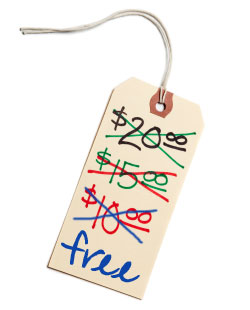
To Free or Not to Free?

Free or not free?
Should you offer your next product for free?
So, you have spent time developing a product (or you are currently in the process of creating one.) One of the major questions you will have is: How do you price your product? Should you price it low, go for the high end…or should you offer it for free?

There are good arguments on both sides of the debate about whether to offer your next product for free; here, I will walk you through them. By the time you finish reading this post, you should easily be able to decide whether your next product should be a free one.

Let’s start with an example: I was listening recently to the Personal Finance Hour with J.D. Roth, owner of the popular blog Get Rich Slowly. He mentioned that he planned to do a series of blog posts and then turn them into an ebook. Almost as an afterthought, he added, “I think I’m going to offer [the ebook] for free.”

Offering a product to the world that you’ve put a significant amount of effort into will return one of two things back to you: reputation or money. What you’re interested in receiving at this time should determine whether you decide to offer your next product for free or as a paid product.

The Case for Free/Reputation

If you are new to an industry, offering a high-quality product for free will immediately establish you as a force to be reckoned with. Reciprocity will kick in, and others will promote it (and you!) via social media and linking. Hundreds or thousands of people will visit and download your product. Some of these people will be influencers; they will write about your product on their blogs, Tweet about it, or email it to all of their friends.

Offering a targeted product for free (such as my Blog Success Manifesto, which is targeted toward bloggers) will help you grow a devoted following of people in your niche. Surveying those on your email list will help you quickly create paid products in your niche; you will have a ready-built audience to sell those products to. If you’re a consultant, for instance, offering a high-quality, free product helping your target audience will enable you to quickly reach people who will pay money for your consulting work.

Whether you choose to write a blog, develop an information product, or develop a standalone product such as a piece of software or a mobile phone application, free will help you build loyalty, trust, and a following.

The Case for Paid/Money

Paid products won’t spread the word about you very quickly. In fact, most people who will promote your paid product will want a cut of the sales–they will want to become affiliates. However, if you have already established yourself as an authority in your industry, I would recommend releasing a line of paid products.

Let’s use J.D. as an example. His blog, Get Rich Slowly, currently has over 69,000 subscribers. It’s safe to assume 1-3% of your audience will buy a paid product you produce. (That number may be higher if you promote it well and it’s a lower-priced product.) Let’s use 3% as the number for J.D., and $17 as the price point for his ebook. 3% of his subscribers means 2,070 sales. At $17 each, that’s over $35,000 in gross revenue. That’s not including additional revenue from new subscribers who buy his product in the future, or a percentage of the revenue from affiliates who promote his product on their own sites.

Of course, having a paid product means you will have to deal with the occasional refund or “Help, I can’t download the file” email–or hire someone to do so. But I’d argue that when the numbers look like they do above, that’s a worthwhile expense. You can outsource this cheaply; spend your time on product creation instead.

Which Should You Choose?

If you are struggling with how price your product, answer this question: Do you need to build a reputation in your industry, or do you want to cash in your earned reputation points?

With my Blog Success Manifesto, I decided I’d rather give up $2,040 in gross revenue (3% of 4000 subscribers at $17 each) and instead build my reputation by providing a quality product at no charge. That was worth it for me; already, over 400 new subscribers have downloaded my Blog Success Manifesto. Since I plan to market products in the future to bloggers, I don’t regret my decision.

But when you’ve already built a huge reputation for delivering quality products, and you’re well-known in your niche, don’t hesitate to cash in your chips. Were I in J.D.’s situation, I would sell the ebook. I would then set a goal of developing a new, related product in my niche every 2-3 months and selling that, as well. Doing that would not only exponentially increase my income (thus affording me new opportunities), but it would allow me to hire someone and feel amazing that I was able to help feed an individual or family due to my creative products.

You Know You’re In the Wrong Place When…

If you’re too far into the “reputation” side of things, you’ll feel it. You’ll be burned out about money and frustrated that no one seems to value your time. In reality, you’re the one not valuing your time by offering products that your audience could benefit from.

In fact, your audience may be begging you to offer paid products. Many times, you will get emails from people you don’t even know, asking “Your ___ is fantastic! How can I help you?” This is a good sign; it means it’s time to take that leap and start turning in your reputation chips for cash.

If you’re too far into the “cash money” side of things, you will also feel it. You’ll be demoralized by the fact that everyone seems to “want a piece of you.” You won’t be able to find many people to promote your product without wanting some of the action.

Try offering some of your best work for free…not the castoffs, but your most original products. Use blogs and social media to build your reputation and your list. Once you’ve built a reputation for offering amazing products at no charge, try selling another product. You will be surprised at the different reaction you get!

A Word of Warning

Building a reputation takes time. Don’t expect to write a document in half an hour, offer it for free, and then immediately cash in your reputation points. If you need quick cash, promote others’ products as an affiliate while continuing to offer excellent work for free. Listening to your audience will help you gauge when the time is right to offer your first paid product.

Treat your reputation like gold. Offer products with integrity and confidence, and enjoy the fruits of building your reputation!

Recommended Reading:

  • Is Your Tribe Holding You Down? Sonia Simone at Copyblogger examines who has it better: the broke “cool kids” or the money-driven Internet marketers. The two tribes parallel this post. A must-read.
  • Blog Success Manifesto. If you’re a blogger, or want to become one, this is imperative. My 62-page guide that shows you step by step how to use a blog to build your reputation.
  • 5 Mid-Year, Game-Changing Questions by Pam Slim. Pam and several others are exploring new ways of doing business online by building your reputation; her article goes along well with this one.

Like this entry? You will love getting my free business tips! No spam, and I won't give your email address to any other company.

Post to Twitter Tweet This Post to Delicious Delicious Post to Digg Digg This Post to Facebook Facebook Post to StumbleUpon Stumble This

Email This Post Email This Post   | Print This Post Print This Post


Previous post in this category: 20 Scam-Free Ways to Make Money Online Fast

Posted on Monday, September 14th, 2009

24 Responses to “To Free or Not to Free?”

  1. Cath Lawson Says:

    Hi Erica – I’ve often wondered whether free products were worthwhile – because many people don’t value free stuff as much.

    I was reading a blog post about an experiment with some famous violinist, whose concerts cost over $100 per ticket. He went out to busk anonymously and nobody stopped to listen to him. It seems crazy that nobody valued his work when it was free. But I guess it also depends on your audience.

    If your potential profits are likely to be small, I guess you have nothing to lose. And building your reputation will be more profitable in the long run.

    Reply

  2. Martha Giffen Says:

    Great and timely advice Erica!

    I am in the process of building a reputation and giving away some of my “babies” that I’ve worked so hard on was difficult for me at first.

    You make an excellent point here. As my list grows to a respectable number, I will then have products of value to offer that my community will be more than happy to buy. Thanks!

    -Martha

    Reply

  3. Stephanie PTY Says:

    Interesting theory, but JD already has tried a pay-ebook in the past, for his Roth IRA series. I think it’s a terrific ebook and definitely worth the price he sells it at. But, my guess is that he’s not seeing a lot of revenue from that, or else he would be selling his next ebook, as well. Pay-ebooks may just not be right for his audience. Or maybe he priced the first one wrong. There are a number of factors that go into it, but I guess my point is that he already tried that once.

    Reply

  4. Neal@wealthpilgrim.com Says:

    First, I think the way you market gives us all a great lesson on how to grow our blogs as a business. Thanks for sharing all you do and your professional approach.

    Regardless of what JD does, your point is a good one and easy to grasp.

    I am grappling with these issues.

    I don’t think my audience is the blogger community. Do I have something of value to say to them? Yes….but it’s just not my core audience.

    It seems like blogging for bloggers makes a lot of sense. It reminds me of the story that the people who made money during the Gold rush in California were the people who sold gold miners tools and equipment – not the miners themselves.

    So, if I am selling information products for retired people or for people who want to retire, is blogging really my most effective media?

    Reply

  5. ericabiz Says:

    @Stephanie: You’ve hit a hot button with me, so in return, you get a passionate response. :)

    You wrote: “Pay-ebooks may just not be right for his audience.”

    I know 100% for certain that J.D.’s audience is FULL of buyers. They buy products left and right. How do I know? Simple: Because J.D. makes a full-time income from his blog.

    This topic comes up over and over again when I talk about how bloggers can make money. “Yeah, I wrote an ebook once and it didn’t make any money, so clearly, my audience doesn’t buy.”

    Oh, they’re buying, just not from *you*! And that’s what is so hard for many people to hear.

    Show me a blogger who says his or her audience doesn’t buy, and I’ll show you a blogger who has no idea what his or her audience wants.

    Folks, you have to start taking this seriously. You will never turn your passion into a full-time income if you produce products that people don’t want (for whatever reason) and then claim that you just can’t make it selling your own products.

    Was the price wrong? No, I don’t think so. Here’s what I think:

    I know J.D. pretty well (as far as non-face-to-face relationships can go. :) Well enough that I felt comfortable using him as an example here. I read every post on his blog and have for over a year. I’ve guest posted on his blog twice, been the featured guest on his Personal Finance Hour, and have chatted with him via Twitter, Skype, and email.

    Not ONCE have I ever heard him mention that he has a product for sale. I have never even seen it on his site!

    The reason I bring all this up is not to bash on J.D. God knows I want him to succeed or I wouldn’t have used him as an example in this article. I get fired up about helping people break through income barriers just like he gets fired up to help people get out of debt and figure out their financial lives.

    If I didn’t know that J.D. had ever released a product, and I follow him this closely, how would anyone else know?

    TOOT YOUR OWN HORN. No one else is going to do it. Get over your fears of promoting your stuff and make sure it gets out there in front of other people. If your products are good (and knowing J.D.’s quality and perfectionism when it comes to blog posts, I have no reason to doubt it is an awesome product), get the word out! Talk about what you’re selling! Be proud!

    To sell a product, you have to get into your customers’ heads. I’ve talked about this several times on this blog, yet I still see it as the #1 mistake people make. Write 10 articles about Roth IRAs based on what people are searching in Google about them. Answer one question per article and then advertise your product at the bottom.

    This is not a small income stream! For many bloggers (J.D. is one of thousands), this is the ticket to a full-time income. It can allow you to quit your job. It can bring you financial freedom.

    You can pay off your entire mortgage in a year or two with a couple of products that you create (passionately) that are best-in-class (because you are an awesome writer) and that you sell with confidence and integrity.

    The only reason it isn’t happening for you is because of fear.

    Don’t know what your readers want? Survey them! Ask! They will tell you!

    Take it seriously. It’s OK to be rich. It’s OK to make a living doing what you love. I give you permission to be successful.
    :)

    -Erica

    Reply

  6. ericabiz Says:

    @Neal: “So, if I am selling information products for retired people or for people who want to retire, is blogging really my most effective media?”

    Most effective? Can’t say for sure (depends on what else you are doing, and how you are tracking leads/conversions.) Extremely effective and basically free? YES.

    You have to know what people are searching for and why they are searching for it. Then you have to target your blog to those results, have a product, and sell it. Along the way, building a list is good (it’s an asset.)

    I teach this in my Be The Authority course, but if you don’t want to buy it when I release it this month, you can figure out how to do it on your own. Learn keyword research. Apply it to your blog. Then sell a product based on what your audience wants. If you already have an audience, survey them (I talk about this in my Blog Success Manifesto.)

    Maximum profitability lies in the intersection between what people are looking for and what product you can offer with integrity and confidence.

    -Erica

    Reply

  7. Susan Says:

    I have been wondering how many people are actually on the net watching baseball training videos. KW research is med. – low.
    And how many will actually read an e-book? We are going forward with the blog and probably the only MLB Vet doing such.
    Matt is a reasonably well known MLB Celeb. His ability to fix these hitters is becoming viral by word of mouth. So do we charge for the intro e-book? As you can imagine, rules seem to differ if your a former celeb, many expect things for free or your just a jerk.

    Reply

  8. Ben Young Says:

    That’s a good way of comparing each, the opportunity cost of providing something for free vs paid. Are we looking for cash now or building something bigger for the future? The decision always has to come down to your business at that point int time.

    I also believe there is room for a third option, the freemium (of which most bloggers do a bit of). Offer the blog or ebook for free charge for your consulting time. We did something similar with my book The Best Ideas are Free – you can read it online for free from anywhere in the world (none of that free in USA only kind of stuff) but if you’d like to download a version; install the iPhone app or the physical book you are going to have to lay out some dollars.

    It works quite well, as new people can engage with you (and help spread the word) and once comfortable they can grab the book. Just throwing that out there :) -Ben

    Reply

  9. Sean Oliver Says:

    Thanks for this exploration. It seems to me that it all comes down to value.

    Reply

  10. Nikc Says:

    This is a great post. I’ve often grappled with what and how much to give away for free.

    In my experience (coming from being in a band) is that giving away a CD, or “product” isn’t necessarily effective if the market is saturated with bands that constantly give away their music for free. The implied message is “This CD is not worth anything so feel free to throw it in the back of your car to melt in the sun”

    The best solution I’ve found in the market-saturation case is to offer one product at a reasonable price. AND one lesser item for free. The key is that the lesser item can be less content, but MUST be of the same quality as the pay item.

    Reply

  11. Dave Says:

    I have a hard time giving away even more than I’m giving away right now. Almost daily posting on two blogs. That’s enough for free!

    Reply

  12. Nick Pfennigwerth Says:

    Give and you shall receive. We live in a perfect Universe and when you give value out of inspiration, you’ll receive ten times more in return than you gave.

    Here is where most people go wrong. They give expecting a return back from the source they were giving too. Or, they give out of need.

    In the first scenario, giving doesn’t work like that. When you give without expectations, then miracles happen.

    In the second scenario, when you give because of your mindset of “need, I need this, need” then your going to receive more desperation in return.

    Give for the sake of giving and because it’s fun. If you’re providing good value out there, then it’s your right to be handsomely rewarded and you will.

    Stay open to the possible channels of receiving, it may not be what you’ve expected

    Nick

    Reply

  13. J.D. Says:

    Interesting discussion, Erica.

    I’m torn on the whole e-book thing. There are a lot of considerations that go into deciding whether or not to charge for it — and how much to charge.

    It’s true that I’ve been able to make a living from Get Rich Slowly, but that’s not really because my audience buys thing. Some folks do buy things, but much of my income has come from people who sign up for services (like bank accounts, etc.). These don’t cost them anything.

    It’s also true that I have a Roth IRA e-book that hasn’t sold much. This is partly because I haven’t promoted it. There are MANY MANY reasons behind this, and I’m not going to go into them here. In reality, I’ve been working behind the scenes to update that book and release it for free on my site.

    And the same is true for the other e-book I want to do. This will be a compilation of a series of posts I have planned for the end of the year. I’ll collect them into a free e-book.

    Why free? Because I don’t need to make money from this. I’d rather use the e-books as something to bring readers in and to support the readers I already have. I’d rather use them to build my audience.

    I’m not saying that I’ll never sell an e-book at GRS. I might. But these two aren’t the books I want to sell.

    There are so many factors that go into this decision, but I can’t share all of them. I wish I could. It just boils down to I don’t need the income from the books, and I’d rather use them to help people and promote the site at this point. :)

    Reply

  14. Scott Webb Says:

    I am battling with this. I am soon to release a service that is blog start ups for people that are having trouble taking action towards their dreams.

    I want to do it for free because there are others doing it for free but I want it to be much more of a relationship, and I want to have a dedicated area just for these people that do take action. 2 of the versions of the service actually do come with a premium wordpress theme so there is some cost the person would have anyways if they did it all themself.

    Bit more service based that information but I am planning to provide free ideas, inspiration and motivationg. I think as long as there is an opportunity cost, you can justify your reason for your price. I’ve found that I love paid products more than anything these days because the content is outstanding, it’s well thought out, and complete. A lot more care can go into things when you’re going to charge someone for it. I’ve been doing a lot of small little things before I release my service to my blog. It’s made things take a big longer but hopefully it makes up for a crappy looking plan.

    Reply

  15. Nikc Says:

    JD, I read your blog and didn’t know you had an ebook about Roth IRAs. I’d be really curious to check it out.

    Reply

  16. Start Internet Business Says:

    Setting prices is sometimes one of the major stumbling block of most online entrepreneurs. Difficulty in setting prices is experienced not only by startup businesses but also established businesses.

    Offering something for free to your target audience is a good way of building a good reputation online. I haven’t looked at it that way before. Thanks for the great tips!

    Reply

  17. Charles J Gervasi Says:

    This makes me think of how this would apply to hardware products. Maybe I could give away all files needed to make a product but also offer an assembled one with a warranted. If volumes are low, and therefore mfg cost high, I could also offer the product as a user-assembled kit until the volumes increase.

    Reply

  18. Natalie at fabeetle Says:

    Great article.

    “…sell a product based on what your audience wants. If you already have an audience, survey them (I talk about this in my Blog Success Manifesto.”

    I’m a fan of ratings and reviews. Your response to Neil’s delima is a good solution. It is a good tip on how to take the second step in social commerce.

    Natalie
    Why do you save & invest?
    fabeetle iPhone giveaway
    http://www.fabeetle.com/giveaway

    Reply

  19. Ray Says:

    “Erica: I know 100% for certain that J.D.’s audience is FULL of buyers. They buy products left and right. How do I know? Simple: Because J.D. makes a full-time income from his blog.”

    “JD: It’s true that I’ve been able to make a living from Get Rich Slowly, but that’s not really because my audience buys thing. Some folks do buy things, but much of my income has come from people who sign up for services (like bank accounts, etc.). These don’t cost them anything.”

    You had to know he would read this.

    Reply

  20. Mrs. Micah Says:

    You don’t have to have an audience full of buyers to make a full-time income. I know a couple personal finance bloggers (and I’m using “know” less loosely here) who do very well in SEO and make $3k/month with AdSense. It’s not their only income, but $36k/year is a living, especially if you’re single/DINK and can budget. So I don’t think you can infer that every blogger who makes a full-time living from their blog has an audience full of buyers. As someone who gives blogging advice, you have a lot of pull with newer bloggers, so choose your assertions carefully.

    I agree with some of the main points of your post, including that once reputation is earned, then it can be banked.

    Reply

  21. Jason R. Ayers Says:

    Creating a great free product as a front-end offer can cause your prospective buyer to say, “WOW! If this person’s free content is this good, what’s the paid content worth?” IF you invest the time to deliver high-quality content.

    Just make sure your free content leaves them wanting more of what you have to offer.

    Reply

  22. Captain-Rob Says:

    Ahoy Erica,

    Nice article. It reminds me of something called the Bikini Principle. Give away 90% of your services for free, build a reputation, and charge well for the extra 10%.

    There are as many business models as there are businesses. You have to pick a model that suits you and your business and run with it. Then adjust constantly as you grow….

    Rob

    Reply

  23. Pace Smith Says:

    This is a great summary of the issues involved, Erica. I’ll point people to this post when they ask why we give away many of our products for free and charge for others. You said it just as well as I could have. (:

    Reply

  24. John Sylvester, (People and Strategy) Says:

    If you look out at the music industry, beverage, social media and a few others there are real struggles with this area. If your business model is one where you believe that you can translate eyes into dollars then it makes sense. People will pay by paying attention in the future across many of these spaces. Just make sure that your playing in the right field when it comes to free…

    Reply


Leave a Reply