
Erica Douglass, entrepreneur and writer About Erica Contact Erica Erica's Goals Erica's Public Speaking erica.biz Archives Erica Douglass

Welcome! I'm Erica Douglass. I am committed to teaching you how to build an inspired, successful business. I would love to hear your opinions and help you grow your business. If you are motivated to change the world and want to learn from my successes (and failures!), please subscribe and join my community!

Scammers Stealing Your Content? How To Craft A DMCA Takedown Notice (And Where To Send It!)

I recently joined The Warrior Forum as part of my quest to learn a lot more about Internet marketing. On it, I found a post from Robert Plank asking how to contact a web host. An unscrupulous scammer had copied some of his paid content and posted it for free.

Copyright infringement is commonplace on the Web, since it’s so easy to copy and paste content and post it on a website. Unfortunately, many web hosts do not respond in a timely manner to copyright infringement complaints, making enforcement more difficult. Since I ran a web host for several years, I know exactly what you need to do to craft a takedown notice, and better yet, how to figure out where to send it.

Robert suggested I put this advice up as a paid article. In this stage of my life, though, I’m more interested in karma than in a few extra dollars, so I decided to put my advice online for free. (If you do find this useful, all I ask is that you subscribe to my blog. That notifies you when I post a new entry…no marketing, no spam, etc.)

Here are my five steps to getting your copyrighted content taken down:

The First Step - Find The Web Host

Go to whois.sc and type in the domain name of your copyright infringer. Take a look at the resulting web page, especially this section:
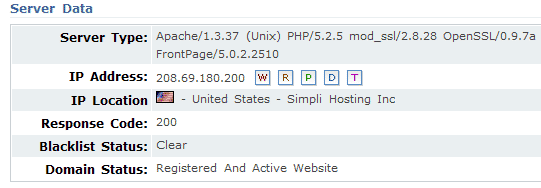
You’re looking for the “IP Location” field. (Note that the screenshot above is for erica.biz…so please don’t email the poor Simpli folks about your copyright infringement. ;) ) The IP Location field should give you the name of a web host you can contact.

Note that this isn’t always accurate. If you’re getting strange results, step to step #4 below and follow the link for finding upstream providers.

If you get a valid response, put the company name into Google and you should find the company’s website.

The Second Step - Contact the Web Host

Prepare your DMCA template for use. Properly format your DMCA request using the ISP template on that page. I strongly recommend that you do not make your request in a Word document, as helpdesk and support systems used by web hosts often strip attachments. Instead, put it in the body of the email. Plain text is best, as you stand less chance of getting caught by a spam filter.

Your first step is to send an email to abuse@[the ISP's domain] using the template and advice above. Use a descriptive subject line — I recommend something like “DMCA COPYRIGHT INFRINGEMENT - {scummy site URL here}” Always give them at least 72 hours to respond — I know it can seem like an eternity, but keep in mind that most search engines won’t even index a page more quickly than 24 hours, and it will often take a lot longer for it to appear in any relevant search terms.

The Third Step - If The Host Doesn’t Respond or Doesn’t Care

What happens if they don’t respond, or worse, they respond with a refusal to take down the content? This is where it pays to get creative.

Almost all of the scummy sites (that aren’t hosted on blog networks, which usually have good abuse departments) are hosted with small hosting companies. After all, they likely know they’ll have to pack their bags in a few days. Better to risk $2 or $3 with some tiny shared hosting company than $3000 with Verizon or AT&T.

Take the web hosting company’s name you found earlier using whois.sc, and check out their website. If they are a good host, they will have a toll-free phone number on the site. Don’t pick up that phone yet, though! You want one other thing…the name of someone as close to the top as possible. See, the customer service rep’s job is to get you off the phone as quickly as possible. The owner or VP of Customer Service, however, does not have the same obligation.

Before you call, go to their About page and see who is listed as the owner, VP of Customer Service, or someone higher up in the food chain. Then, when you call, ask directly for that person. If they ask what your call is regarding, say you have a problem with one of their customers, but don’t get into specifics. The goal is to talk to a higher-up as quickly as possible.

If you get voicemail, calmly leave a message explaining the problem, and ask for a call back as soon as possible. Don’t yell, scream, or make accusatory comments. You want the host to want to help you. If they don’t call back within 24 hours, call again.

Hopefully, at this point, you will have contact with a higher-up. Explain your situation. You have something in common with this person: you both want to make money and be treated fairly. At this point, 99 out of 100 times, the problem will get resolved quickly, because you have a VP or owner who is looking into the situation.

The Fourth Step - Go Higher Up The Hosting Chain

No luck with the first host? Most hosting companies use servers and/or bandwidth from other parties. For instance, when I was running Simpli, we purchased bandwidth from other providers. It was common for us to receive DMCA complaints CC’ed to the abuse department of our upstream providers as well. Here is an excellent tutorial for finding upstream providers. Use this, or ask a more technical friend to help you. (Here is an online traceroute tool — just type in the hosting company’s domain. You can use whois.sc for whois lookup.) Once you have the upstream provider(s), start over at step #1 and email those upstream providers. Going to upstream providers works quite effectively if the initial hosting company fails to respond.

The Fifth Step - The Step I Hope You Never Have to Use

Maybe you’re talking to a newbie host who doesn’t understand that you have copyrighted content, or maybe you’ve left repeated calls and emails with no response. If a week goes by and there is no response, it’s time to take further action. Please note that I do not recommend this except as a last resort.

Most hosts are reasonable. In the off chance that you get one who is not, even after escalating, I recommend you create a post on Web Hosting Talk. Calmly and coolly state your site, your copyrighted content, the host’s name, and the steps you have taken to get this resolved. Put the host’s name and website in your title so others can see when they search Web Hosting Talk. Web Hosting Talk is the largest resource for web hosts, and a bad review of a host on Web Hosting Talk can damage a host’s reputation.

If you get this far, there are also other alternatives you should explore. Contact the copyright infringer’s domain name registration company (that information is on the whois.sc page for the scammer’s domain as well.) Some will suspend the domain for a DMCA complaint, but most will not.

Notify Google and Yahoo so the site will be blocked from their search engines:
Google - Report a Spam Result
Yahoo Spam and Deletions

A Final Note - What If It’s Not Copyrighted?

Since I have dealt with this before from a web hosting company owner perspective, I wanted to cover it here as well. What if the copyright is not copyrighted — it’s just something you don’t like? Libel and “parodies” fall into this category, as well as sites that look a lot like yours or stole some of your HTML source code.

This is a gray area. As a web hosting company owner, I fought for freedom of speech for all our customers. We had many “abuse” complaints where someone didn’t like what was being said about them or their company. We hosted review sites and had companies come after us with DMCA takedown notices because someone had posted a bad review on those sites!

I ask you to only use DMCA takedown notices for actual copyrighted content. If someone posts a bad review of your company or does something you don’t like, it is not within your rights to ask for it to be taken down unless it is patently false (i.e. that person was never a customer of yours.) It is your responsibility as a business owner to respond reasonably and clear up the issue from your end. A bad review handled well can actually mean fantastic publicity for your company. Please handle bad reviews or things you don’t like as a separate issue.

I wish you the best of luck getting your content out of the scammers’ hands!

Like this entry? Subscribe to this blog and receive an email update whenever a new post appears on the site! No spam, and I won't give your email address to any other company.

Email This Post To A Friend Email This Post To A Friend

book mark Scammers Stealing Your Content? How To Craft A DMCA Takedown Notice (And Where To Send It!) in del.icio.usBookmark in Del.icio.us  |   See this page in technoratiTechnorati  |   submit Scammers Stealing Your Content? How To Craft A DMCA Takedown Notice (And Where To Send It!) to digg.comDigg This!  |   review Scammers Stealing Your Content? How To Craft A DMCA Takedown Notice (And Where To Send It!) on StumbleUponReview on StumbleUpon


Previous post in this category: Why Your Business Isn’t Doing As Well As It Could Be

6 Responses to “Scammers Stealing Your Content? How To Craft A DMCA Takedown Notice (And Where To Send It!)”

  • Hakim Chishti:

    Hi Erica,

    Great information. We have used many of these same tactics ourselves over the past few years to stop infringement of our own and many clients’ intellectual property.

    We even stopped an infringer of an artist’s work being carried out in China! So, these tactics do work. A lot of persistence is required, as you note.

    One point that may make things easier — in order to be protected against damages under DMCA, a company MUST provide the name of the Company’s Designated Agent to receive notification of alleged infringement. Usually that person is named in the Terms of Service page, or elsewhere under one of the “About Us” or “Contact Us” pages.

    Once you have the name of that person (it is sometimes a contact at their law firm), things move very fast. Either we or our attorney first makes contact with an e-mail. If the case is important enough, we also send a FedEx letter. We have never failed to close down an infringer in almost five years.

    Another point to stress is that it is also a crime to make false allegations of infringement. The penalties are quite severe. One should never try to use such tactics to “punish” or “get even” with a competitor or anyone else.

    As you well know, these are very aggressive tactics that should only be used when truly appropriate.

    I always advise people who lack extensive online or business experience to contact an IP attorney, simply to avoid getting themselves into a legal mess that could be expensive to get out of.

    BTW, why do you disallow people to copy the materials above you provided? I wanted to save it to provide a shortcut sheet for our own use. I find it a bit petty that you provide all the info, but make it tortuous to actually reference and use it. Of course anyone can copy down the pages, if they want to.

    Anyway, thanks again.

    All the best,

    Hakim Chishti

  • Hakim Chishti:

    P.S. to the foregoing —

    Each host, ISP or web site that wishes to maintain the liability protections afforded by the DMCA, must fill out and file (and pay a fee) a registration statement designating who is your “Authorized Agent to Receive Notice.”

    You don’t have to do this, but you will lose the protection of the DMCA if you do not.

    Full details here, along with the forms and fees to send: http://www.copyright.gov/onlinesp/.

    Also, we advise everyone to actually file Copyright for the content of their web site. It only costs about $45 and will greatly enlarge one’s protections, and must be done in order to collect damages and file injunctions, among other things.

    Hope this helps.

    Hakim Chishti

  • Reese Spykerman:

    Hi Erica,
    Found your link through problogger’s twitter feed. I wrote a similar piece on my blog, but not nearly as extensive and full of insider info as yours. This is great stuff!

    One thing I struggle with is being tired of the time involved in filing complaints. There was a point where our content was stolen at least once a week. I had to assess how much was taken, and if it was a small amount, sometimes I let it go because it was unlikely to raise a duplicate content flag to the search engines.

    Many times the site owner will take it down after an email from me. But site owners in non-western countries tend, in general, to be less agreeable to doing this and simply ignore my email.

    I’ve also found when dealing with GoDaddy as a registrar or host, they ask proof of copyright registration of the content in question. Because my site changes frequently, it’s a pain to file an official copyright claim on it all the time.

    When I do write to violators, I let them know I have no qualms about filing a spam claim with google and yahoo. That tends to get their attention more than anything else. :)

  • ericabiz:

    Hi Reese! Thank you for the thoughtful comment. :)

    I understand what you’re saying. I’ve had content from my RSS feed stolen countless times, and this isn’t a huge site (~8000 unique visitors in January.) It might be worth it at some point to hire someone to deal with the scammers. You should be able to train someone to do it quickly. That depends on the return the site gives, you, though — in my case, since I don’t currently run ads on erica.biz, it probably wouldn’t be worth it.

  • Kevin Mark:

    Hi Erica,
    you can also use technical means like checking if a suspect domain is accessing your content and create a blacklist. you can replace the content with something (neutral, bad or evil) or block the content from being sent. This would not stop a ‘copy and paste’ but at least that would increase the cost to the evildoer. (I was also suprised that you did not say to simply contact the evildoer first vs the isp or host).
    -k

  • Matthew:

    I started up in the hosting business back in August 2001 and sold a few years later and left the hosting industry earlier last year. I decided to build my own websites and go down that path of creating content and leaving the hosting to someone else :) It gives me time to breath, have time off and not worry as much. Also what’s cool is that I earn what I was earning in the hosting business now, but can sleep at night.

    Since starting with my own content based website I have grown it from zero to about 200000 visitors per month which I am happy with as it is still growing. In recent months I have been subject to a number of scrapers stealing content to try and profit from my work. However, I have not needed to send a DCMA notice to anyone yet. I have only asked 1 website to take down my work and he did with in minutes of my request (I got lucky with that request maybe).

    Rather then email them I just try deeplink between my content pages. When scrapers steal my content they also create link backs to my other pages and in the grand scheme of things they actually help me get higher rankings with Google which in turn, sends more traffic to me and makes more money.

    For a little bit of an explanation on what I mean it could be worth you reading http://www.blogstorm.co.uk/foil-scrapers-improve-rankings/

    It relates more to blog scrapers who use RSS feeds to take content, but any content that is stolen will benefit should you have a fairly trusted site.

    I am going to bookmark this blog Erica as I have seen your previous business around quite a bit (being in the same industry around the same time). You have some great content on here! Keep it up and I am confident you will reach that 1 Mil a year goal :)

Leave a Reply

XHTML: You can use these tags: <a href="" title=""> <abbr title=""> <acronym title=""> <b> <blockquote cite=""> <cite> <code> <del datetime=""> <em> <i> <q cite=""> <strike> <strong>


Google